


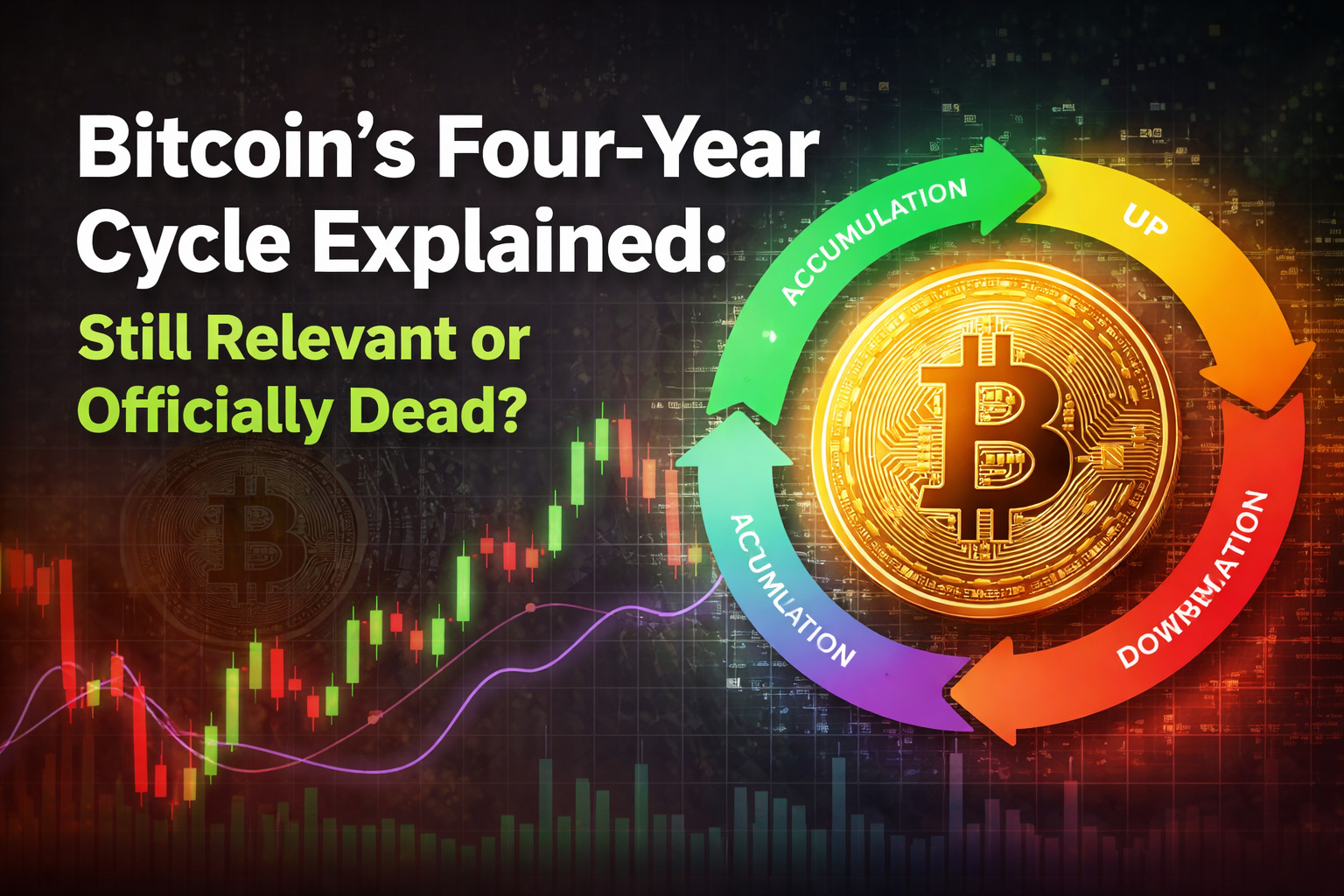
Bitcoin’s four-year cycle is one of the most talked-about patterns in crypto. But what does that mean? It comes from the way Bitcoin reduces its supply over time, creating predictable moments when new coins enter the market more slowly. These moments often shift how people buy, sell, and hold BTC. Analysts and data firms have noticed trends that move in waves, affecting both Bitcoin and other cryptocurrencies.
Why does this cycle matter? Unlike traditional assets, Bitcoin’s supply is fixed in code. This makes it possible to know when scarcity will increase and mining rewards will change. Observers have tracked past cycles and seen similar phases: accumulation, rising activity, corrections, and renewed momentum. It’s like the market follows a rhythm, even if it’s not perfect.
Even today, with big institutions, ETFs, and global economic pressures in play, the four-year cycle is still a key reference. Each halving has happened under different conditions, which adds new factors to how the cycle unfolds. This mix of coded scarcity and global events makes Bitcoin’s pattern a blend of math, psychology, and economics.
This guide will show how the cycle works, why halvings matter, how past events played out, and whether this pattern still influences Bitcoin in today’s market.
Bitcoin Halving Explained
Bitcoin halving is a built-in event in the network that cuts miner rewards in half every 210,000 blocks. This happens roughly every four years. Why exactly? It slows the creation of new Bitcoin and keeps the supply predictable, aiming for a total of 21 million coins.
Miners earn a block reward when they successfully add a block of transactions to the blockchain. This reward includes new Bitcoin plus transaction fees. And why do miners care? Because it motivates them to secure the network and keep transactions running smoothly. It’s also the main way new Bitcoin enters circulation.
At Bitcoin’s launch in 2009, miners earned 50 BTC per block. Each halving has reduced this amount: 2012 brought it to 25 BTC, 2016 to 12.5 BTC, 2020 to 6.25 BTC, and 2024 to 3.125 BTC. The next halving, expected around 2028, will drop the reward to about 1.5625 BTC.
Blocks are mined roughly every 10 minutes, so 210,000 blocks usually take around four years. Can the timing change? Yes—network conditions can speed or slow block creation slightly. Halving is a clever way Bitcoin stays scarce and helps maintain its value over time.
How Bitcoin Halving Creates Scarcity and Protects Value
Bitcoin’s halving was created by its mysterious founder, Satoshi Nakamoto, to mimic the scarcity of precious metals like gold. By slowing the creation of new BTC, the system helps control inflation and keeps the total supply predictable over time.
Unlike fiat money, which central banks can print at will, Bitcoin’s issuance is fixed by code. No more than 21 million coins will ever exist, and each halving steadily reduces the rate of new supply entering the market. The predictable scarcity gives Bitcoin deflationary traits, making it potentially more valuable over time compared with traditional money.
Halving also has real-world effects on the Bitcoin ecosystem. It slows the flow of new coins, which, if demand remains steady or rises, can put upward pressure on prices over the long term. It affects miner economics, pushing less efficient miners out and increasing competition.
Over multiple cycles, halvings reinforce Bitcoin’s scarcity story, showing how supply tightens naturally. Analysts and market observers use these events to track trends, understand digital scarcity, and evaluate Bitcoin’s potential long-term value. In essence, halvings highlight why Bitcoin remains rare and widely followed around the world.
The Mechanics Behind Bitcoin Halving
Bitcoin halving is based on block height, not a calendar date. Once 210,000 blocks are mined after the last halving, the network automatically cuts the block reward by 50%. This rule is built into Bitcoin’s code and cannot change without agreement from the entire network, making it immune to central control.
Separately, the protocol adjusts mining difficulty roughly every two weeks, or every 2,016 blocks, to keep the average block time near 10 minutes. Halving itself doesn’t change this difficulty. However, as rewards shrink, some miners may leave if mining becomes less profitable. Over time, these shifts can subtly influence network participation while keeping Bitcoin secure and predictable.
Stages of the Bitcoin Halving Cycle
Bitcoin’s four-year cycle isn’t random. It tends to follow distinct stages shaped by supply, market psychology, and global trends. Understanding these stages helps analysts and participants see where Bitcoin may be in its cycle.
- Accumulation Phase (Pre-Halving Period)
This phase usually starts 6–12 months before the halving. Prices often move within a narrow range as experienced holders slowly accumulate Bitcoin. Trading volumes are modest, and general public attention is low. During this time, “smart money” builds positions strategically, while newer or less informed participants remain mostly on the sidelines. Market movements are subtle, but this quiet phase sets the stage for what comes next.
- Pre-Halving Rally
About 2–3 months before halving, the market often enters a noticeable uptrend. Anticipation of reduced supply drives demand from both retail and institutional buyers. Media coverage grows, attracting broader public attention. Trading volumes rise, and more participants enter the market. Prices generally climb as optimism builds. This rally often marks the start of a more active phase in the cycle, signaling growing confidence in Bitcoin’s scarcity-driven narrative.
- Pre-Halving Retrace and Sentiment Reset
In the final weeks before halving, prices may pull back temporarily as some traders take profits. Sentiment can shift from excitement to cautious neutrality. Historical cycles show retracements ranging from 20% to 38%. This natural pause tests investor confidence while the market prepares for the structural supply change caused by halving.
- Post-Halving Re-Accumulation
Right after the halving, Bitcoin often enters a consolidation phase. Prices stabilize as the market adjusts to new supply. This period can last several weeks or even months. Long-term holders may continue accumulating strategically, while short-term speculators reduce exposure. Network activity, including transactions and on-chain movements, tends to increase as cautious new participants engage. The market is quieter than during a rally, but this stage sets the foundation for the next upward movement.
- Parabolic Uptrend (Bull Market Expansion)
6 to 18 months after the halving, Bitcoin often experiences a strong price surge. Reduced supply meeting rising demand fuels momentum, sometimes reaching new all-time highs. Institutional participation grows, retail interest peaks, and media coverage amplifies awareness. Volatility rises, with large price swings reflecting both excitement and speculative activity. Market enthusiasm drives broader adoption, but sharp movements remind participants that the market remains unpredictable.
- Peak and Distribution Phase
Eventually, the market hits a peak. Buying pressure slows, and large holders often start taking profits. Volatility remains high, and prices can swing dramatically. Sentiment shifts from euphoria to caution. This phase signals the end of the bull run and prepares the market for a corrective period.
- Correction and Bear Market
Following the peak, Bitcoin may enter a prolonged correction. Prices can drop 60–80% from the cycle high. Weak hands exit positions, while long-term holders continue accumulating. This stage restores balance, reduces speculation, and sets the stage for the next accumulation phase.
Remarkably, each stage interacts with mining activity, liquidity, macroeconomic events, and institutional flows. Miner behavior post-halving can influence short-term volatility, while external events can amplify or dampen market effects. These factors make every cycle unique, even as the overall pattern repeats, blending Bitcoin’s coded supply with real-world market dynamics.
History of Bitcoin Halvings (2012–2024)
Since Bitcoin launched in 2009, its issuance has followed a strict, pre-programmed schedule. This system controls supply and shapes market behavior over time. A key part of this schedule is the halving, which cuts off the block reward roughly every four years. These events increase Bitcoin’s scarcity and often mark turning points in its market cycle. They are central to how long-term holders and analysts understand Bitcoin’s price trends.
Bitcoin’s First Halving — November 28, 2012
The first halving happened in late 2012, reducing the block reward from 50 BTC to 25 BTC. Who was even using Bitcoin at that time? Mostly early adopters, hobbyist miners, and developers. Prices were still modest, trading around $12 to $13, and mainstream awareness was minimal.
After the halving, fewer new coins entered the market. This reduction in supply helped set the stage for Bitcoin’s first major bull run. By late 2013, the price had surged past $1,000. How did it rise so fast? Scarcity combined with growing public interest, speculation, and increasing adoption among early enthusiasts is driving strong demand.
This cycle brought Bitcoin into broader financial discussions and showcased the power of digital scarcity. It also demonstrated that coded rules in the network could influence real-world markets. While mainstream adoption was still limited, this first halving laid the foundation for understanding future cycles. It proved that predictable supply, combined with human behavior, could create significant market shifts.
Bitcoin’s Second Halving — July 9, 2016
By 2016, Bitcoin had grown far beyond its early hobbyist roots. Exchanges were easier to access, merchants were experimenting with Bitcoin, and communities had spread worldwide. Then came the halving. The block reward dropped from 25 BTC to 12.5 BTC. Prices hovered around $600 to $680.
Did the price explode instantly? Not really. The market moved subtly at first, quietly adjusting to the lower supply. Long-term holders continued accumulating, while short-term speculators stayed cautious. Over the next year, interest surged. Retail buyers jumped in. Futures trading platforms appeared, allowing more people to participate in new ways. Volatility spiked as excitement and speculation collided. By December 2017, the apex coin touched nearly $20,000. The digital currency had finally grabbed mainstream attention, and even skeptics were talking.
Institutional players began experimenting as well. Banks and financial firms published research, offered derivative products, and explored Bitcoin’s potential. Exchanges adapted, and custody solutions slowly expanded to meet growing demand. The cycle still felt wild and unpredictable, but the audience was no longer just crypto enthusiasts. Bitcoin had begun bridging the gap between early adopters and a wider financial world.
Bitcoin’s Third Halving — May 11, 2020
Fast forward to 2020. The world was grappling with a pandemic. Economies were unstable, inflation worries loomed, and people searched for alternative stores of value. Bitcoin’s third halving arrived, cutting rewards from 12.5 BTC to 6.25 BTC. Prices were around $8,500 to $9,000.
Who was paying attention this time? Not just hobbyists, institutional investors, hedge funds, and corporate treasuries were stepping in. They viewed Bitcoin as a hedge, a potential safe harbor amid economic uncertainty. The reduced supply amplified the effect. Interest exploded. By November 2021, BTC surged to roughly $69,000.
This cycle marked a turning point. Custody solutions expanded. Companies like Strategy (formerly MicroStrategy) added Bitcoin to their balance sheets. Scarcity, growing institutional demand, and mainstream adoption combined. Notably, the pioneer cryptocurrency had evolved from a fringe experiment into a recognized digital asset shaping global financial discussions. Its coded scarcity proved capable of influencing real-world markets in dramatic ways.
Bitcoin’s Fourth Halving — April 19, 2024
The fourth halving took place on April 19, 2024, and reduced the block reward to 3.125 BTC. By this point, Bitcoin had grown far beyond its early user base. It was now a global digital asset supported by U.S. spot ETFs, major exchanges, institutional custody platforms, and traditional finance participants. The ecosystem felt larger and more structured than in previous cycles.
Leading up to the halving, Bitcoin’s price moved around $60,000 to $65,000. This range reflected both market expectations and broader economic conditions. Many participants believed the event had already been priced in before it happened. After the halving, price movement followed a different pattern than earlier cycles. Bitcoin did reach new highs in late 2024 and early 2025. However, the gains were more measured. Instead of soaring hundreds or thousands of percent, prices rose more modestly.
These softer moves sparked debate. Some analysts suggested the halving’s influence was weakening as Bitcoin matured. Others argued the effect was still present but blended with new factors.
The reduced supply still mattered, but it no longer acted alone. Bitcoin’s deeper integration with traditional finance created more stable behavior. Global macroeconomic trends also shaped market reactions more strongly than in the early years. Together, these elements signaled that the 2024 cycle reflected a more mature and complex Bitcoin landscape.
Halvings Into the Future
Bitcoin will keep going through halvings until the block reward gets very close to zero, which should happen around 2140. By then, almost all 21 million coins will already exist, and miners will rely mainly on fees. The next major halvings in 2028 and 2032 will continue slowing new supply, but the impact may feel different as the market becomes more mature. Global conditions, liquidity shifts, and new forms of participation will shape each cycle. Yet halvings remain one of the most defining parts of Bitcoin’s economic structure.
Bitcoin’s Price Behavior Around Each Halving and Its Impact on the Broader Crypto Market
Bitcoin’s halvings have created clear market reactions over the years, but no two cycles behaved the same way. Each event happened in a unique environment, so the price outcomes often reflected the mood of the broader market at that time. The effects also spread into the rest of the crypto world, influencing liquidity, dominance, and activity in many altcoins. Researchers often rely on on-chain data and market reports to understand how these patterns formed.
Price outcomes by halving
2012 → 2013:
The first halving pushed Bitcoin from low double-digit prices into a major discovery phase. The price climbed toward and beyond $1,000 as the year progressed. This period also marked Bitcoin’s first big media wave, which introduced the asset to far more people around the world. Many new users entered the market simply because the growing attention made Bitcoin feel exciting and unfamiliar.
2016 → 2017:
The second halving set the stage for the huge rally in 2017. Bitcoin expanded sharply over the next 12 to 18 months as new exchanges made access easier. Futures markets and rising retail demand added even more energy to the price action. Early institutional interest also appeared, which shaped volatility and deeper liquidity.
2020 → 2021:
The third halving arrived during global uncertainty and heavy economic stimulus. Bitcoin climbed for months and eventually reached new all-time highs in 2021. Large spot flows and active derivatives added strength to the move. Corporate allocations also created steady demand.
2024 → 2025:
The April 2024 halving reduced new supply again and created a slower market response. Bitcoin spent months moving within the $60k to $90k range as the market adjusted to tighter issuance. Momentum shifted later in the year when Bitcoin finally broke above $100,000. That move signaled renewed strength after a long consolidation period.
The rally continued into 2025 and pushed Bitcoin to fresh highs. It eventually climbed beyond $126,000 in October 2025, showing that the cycle still held upward pressure. Many analysts still called the period weaker than past cycles, but the post-halving structure remained a major force in the market.
What Changed Across Cycles
Two things changed across Bitcoin cycles: market composition and liquidity with derivatives.
- Market composition shifted as the space matured. Early cycles were driven by retail activity, which created big emotional swings. Things changed once institutions entered with larger balances and calmer strategies. Their presence reduced the huge spikes that often followed halvings. Spot ETFs and company treasuries also added steady demand that felt more structured.
- Liquidity and derivatives grew quickly over recent years. Tools like futures and options made hedging easier for bigger players. These tools can boost strong moves but also limit extreme rallies. Together, they make the market feel calmer and more complex today.
How Halvings Reverberate Through the Crypto Market
- Altcoins and Bitcoin dominance: Halvings often shift how money moves between Bitcoin and altcoins. After strong Bitcoin uptrends, people usually move profits into smaller assets. This pattern appeared after the 2016 and 2020 halvings when Bitcoin’s dominance fell. Altcoins then enjoyed large moves because money rotated away from Bitcoin. The rotation usually arrives months after Bitcoin’s main surge, creating a second wave of activity across the market.
- Liquidity migration: Bitcoin rallies often pull liquidity away from smaller tokens. Money usually flows into Bitcoin first because it feels safer during sharp moves. Later, liquidity returns to mid and small caps when profit-taking starts. That creates rolling activity across different assets. In 2024, the pattern shifted at times. Bitcoin stayed calm while new on-chain trends pushed network fees higher. These changes affected miner income and shaped short-term liquidity behavior.
- Market psychology and media cycles: Each halving boosts media attention and brings fresh interest into crypto. As the market matured, reactions followed macro headlines more than halving news. ETF flows also played a larger role. This reduced the halving’s standalone impact on overall sentiment.
Practical Implications for Participants
- Timing is less mechanical than before: The halving still reduces new Bitcoin supply, but reactions feel less predictable today. Outcomes depend on where the money comes from and how confident those players feel. Retail behaves differently from institutions, and that creates mixed signals. Macro liquidity also shapes reactions because global conditions influence risk appetite. Derivative positions matter too because they can amplify or soften moves. It’s safer to see the halving as one factor, not the main driver.
- Watch dominance and liquidity flows: Market moves often show early hints through dominance shifts. A quiet Bitcoin move with rising on-chain activity can signal altcoin rotation. This pattern usually appears when profit-taking grows. Broad ETF inflows can delay that rotation by keeping attention on Bitcoin. Strong ETF demand often supports dominance and limits altcoin momentum. Tracking dominance, ETF flows, and on-chain metrics helps show which direction the cycle is leaning.
Key Factors Influencing Bitcoin Price Movements Near Halving Dates
Bitcoin’s price during halving periods comes from several moving parts. Some are built into the protocol itself, while others come from how the market behaves. Broader financial conditions also shape reactions. These forces interact in ways that feel complex, and understanding them helps explain price patterns before and after each halving.
1. Protocol-Level Factors
- Halving and the scarcity effect.
A halving cuts Bitcoin’s block reward in half every four years. This slows how much new Bitcoin enters the market. After the 2024 halving, daily new supply dropped from about 900 coins to around 450. This slower issuance supports Bitcoin’s fixed-supply story. When demand holds steady or grows, reduced supply can support higher prices. The effect is not automatic, but it often influences long-term sentiment.
- Network hash rate and miner economics.
Miners protect the network and receive block rewards for their work. Halving events reduce those rewards, which lowers miner revenue in BTC terms. Less efficient miners may feel pressure and sometimes sell more Bitcoin to cover costs. That selling can influence the market during difficult periods. When Bitcoin trades above mining costs, miners may sell less, easing pressure. Hash price declines in recent cycles forced miners to find cheaper power or expand into new income streams
Hash rate trends also send clear signals. A strong or rising hash rate after a halving shows miner confidence. This can support network security and help stabilize overall market sentiment.
2. Market Structure and Liquidity
- Exchange-traded funds (ETFs) and institutional flows.
Spot Bitcoin ETFs have changed how prices react around halvings. They take supply off exchanges for safe custody. This reduces available coins for trading and makes prices more sensitive to demand. Since the 2024 halving, institutional money has used ETFs to enter Bitcoin in a regulated way. Large flows through ETFs can move prices quickly because fewer coins are available for everyday trading. Even small inflows can have outsized effects in these tighter conditions.
- Active supply and trading liquidity
Trading liquidity depends on how much Bitcoin is actually moving in the market. Many holders keep their coins long-term, which limits active supply. Yet, a significant portion of BTC still circulates daily. Changes in this active supply can drive volatility, especially near halving events. When active supply is low, price swings can be larger. Monitoring both ETF demand and active trading coins helps explain why markets behave differently around each halving.
3. Derivatives and Market Sentiment
- Futures and funding rates.
Bitcoin’s derivatives markets, like futures and perpetual contracts, can amplify price moves. High leverage can make rallies sharper or sell-offs deeper. When futures traders are overly bullish, funding rates rise, adding extra buying pressure. When markets turn bearish, funding rates can flip, hinting at potential corrections. These signals vary across exchanges, but the structure of derivatives often intensifies swings near major events like halvings.
- Sentiment and psychology.
Market psychology strongly affects crypto behavior. Anticipation of post-halving gains can attract speculative demand before the event. Afterward, profit-taking or “sell the news” reactions often appear. Narrative cycles, from FOMO to fear and regret, drive short-term moves. Sentiment can be measured using tools like the Fear & Greed Index or social media activity. These signals help explain why markets sometimes move unpredictably around halvings.
4. Macroeconomic forces
- Global liquidity and monetary policy.
Bitcoin reacts to broader financial conditions like interest rates, inflation, central bank liquidity, and geopolitical risks. These factors determine whether Bitcoin behaves as a risk-sensitive asset or a macro hedge. Coinbase research shows that post-halving price behavior often aligns with macro trends. Periods of abundant liquidity or expected rate cuts usually benefit risk assets, including Bitcoin. Conversely, tighter monetary policy or a stronger U.S. dollar can reduce risk appetite, pressuring Bitcoin’s price.
- Regulatory and policy environment.
Government actions and regulatory clarity also shape market sentiment and liquidity. Supportive frameworks can boost confidence and attract capital. Uncertainty or restrictive rules can create selling pressure, especially during broader market stress.
It is worth noting that the effects of the discussed factors are not straightforward or linear. Miner selling may be limited if ETFs absorb extra supply. Macro liquidity injections can boost speculative sentiment and push prices higher. A strong hash rate after a halving signals miner confidence, which can support price stability and reduce fear-driven selling.
Bitcoin’s price near halving events reflects many forces at once. Supply mechanics, miner behavior, liquidity conditions, sentiment cycles, and macroeconomic trends all play a role. No single factor dominates. Understanding how these elements interact helps explain why prices do not move solely because of halving mechanics. The broader market and economic context shape real outcomes.
Recognizing this interplay gives a clearer view of Bitcoin’s behavior, especially around major protocol milestones like halvings.
Expert Views on the Future of the Four‑Year Cycle
Experts are divided on whether Bitcoin’s four-year halving cycle still shapes prices. Some believe it does, while others see change, asserting the trend is dead. Why the split? Markets, investor behavior, and macro conditions have evolved, creating new dynamics.
- Traditional Cycle Supporters
Supporters say the halving schedule still matters because each event permanently cuts new supply. Does that mean prices must rise? Not always, but reduced supply often reinforces scarcity over time. Models like stock-to-flow suggest lower issuance supports price increases after each halving. These forecasts indicate post-halving cycles can still show strong gains, though timing and magnitude vary. Historical patterns imply that high price levels could appear months or even years after the halving.
Even bullish analysts urge caution on timing and volatility. Could the next peak happen immediately? Sometimes, but many expect slower moves. After the 2024 halving, appreciation might extend into 2026 and beyond rather than peaking quickly in 2025. Structural changes, like ETF liquidity and institutional adoption, can stretch or shift the pace of capital flows.
Overall, supporters see halvings as important anchors in Bitcoin’s economic design. While the cycle alone doesn’t guarantee gains, understanding it alongside market changes helps explain why prices can move gradually and why long-term trends remain relevant.
- Institutional and Macro-Focused Views
Some experts, including those at Grayscale, argue that Bitcoin’s traditional halving cycle is becoming less reliable for predicting prices. Institutional capital now drives much of the market movement. Money flows through ETFs, corporate treasuries, and regulated investment vehicles instead of being dominated by retail activity. These inflows are patient and long-term, which helps reduce the sharp spikes and crashes seen in earlier cycles.
Grayscale emphasizes that the supply impact of each halving is gradually declining. With more of Bitcoin’s 21 million coins already in circulation, the newly mined supply affects the market less than before. Macroeconomic forces like interest rates, liquidity, fiscal policy, and regulatory clarity now play a stronger role in price behavior than the halving alone. In this view, Bitcoin is evolving toward an asset influenced by broader economic trends rather than just its programmed issuance schedule.
The firm also notes that the 2025 price pullback looks more like a typical bull-market correction than a post-halving bear trend. Analysts see this as a sign of a maturing market with deeper institutional involvement. While halvings remain important, their influence on cycle timing and peaks is weaker. Prices today react more to capital flows, market structure, and macro conditions than to halving mechanics alone.
- Alternative Analyst Perspectives
Some research firms, like K33 Research, argue Bitcoin’s four-year cycle may be losing relevance. They note that Bitcoin’s role in diversified portfolios often outweighs halving timing. Global economic pressures and macro factors now shape price behavior more than programmatic supply changes.
Analysts like James Check also suggest long-term cycles are increasingly tied to adoption trends and market structure, rather than strict halving schedules. Previous cycles were influenced by retail adoption, leverage-driven volatility, and emerging institutional participation. Future cycles may follow different drivers as the market matures.
- Community and Market Sentiment Signals
Crypto communities and commentators reflect a split view on the halving cycle’s relevance. Some see predictability weakening, citing slower price movements compared with earlier cycles and the impact of ETFs and institutional flows. Others believe the cycle may not disappear but evolve into a “supercycle,” with new highs potentially appearing in 2026 or 2027. This perspective suggests the market could stretch beyond the classical four-year peak.
Community sentiment, combined with broader adoption and institutional trends, shows that Bitcoin’s cycles are becoming more complex. Understanding both analyst research and community views helps beginners see how halving effects are influenced by multiple factors. These influences now overlap, rather than following a single simple timeline.
Why Bitcoin Four-Year Cycle May be Dead and the Growing Role of Macroeconomic Forces
In Bitcoin’s early years, the four-year halving cycle often explained price moves. Scarcity from supply cuts usually pushed prices higher. But today, the story is no longer the same. Broader economic forces and market structures now influence price more than the halving itself. This change has reshaped how participants view Bitcoin’s price beyond the traditional cycle. Let’s discuss them:
Diminishing Supply Shock Effect
Each halving reduces Bitcoin’s inflation rate, but its impact is shrinking. By the 2024 halving, annual inflation dropped below 1%. Why does this matter? Because with around 94% of all Bitcoin already mined, future halvings adjust supply by ever-smaller amounts. That means the historical “supply shock” effect can no longer move prices as dramatically on its own.
Analysts note that when new supply is a tiny fraction of the total, halving alone creates little market pressure. Instead, liquidity, or the flow of money into and out of markets, has a stronger impact on price. Capital flows, investor behavior, and macroeconomic conditions now weigh more heavily than programmed supply reductions. This shows that halvings influence price, but many other factors now play an equally important role in Bitcoin’s movements.
Institutional Adoption and Market Structure
The rise of institutional investment channels, like spot Bitcoin ETFs, has changed how demand affects price. Since 2024, large capital flows from institutions have increased Bitcoin ownership through regulated products. These flows take supply directly from the market, reducing the halving’s visible impact.
Institutions often buy using strategies like time-weighted average price (TWAP), which spreads purchases over time. This smooths price action and limits volatility compared with earlier cycles driven by retail speculation. Corporate treasury adoption adds another layer, as companies hold Bitcoin for the long term and react less to short-term cycle narratives.
Together, these dynamics help stabilize Bitcoin’s price. Large, patient holders reduce extreme swings, making post-halving price jumps less dramatic than in the past. While halvings still affect supply, institutional accumulation and market structure now play a bigger role in shaping Bitcoin’s movement.
Macroeconomic Forces
Honestly, Bitcoin isn’t just about halvings anymore. These days, global economic conditions often drive price moves more than the block reward. Think about central banks and interest rates. When they inject cash through quantitative easing, investors hunt for returns anywhere—Bitcoin included. But when rates rise, or the U.S. dollar strengthens, speculative demand drops, and Bitcoin can slow down too.
It’s not just money supply either. Geopolitical tension, national debt worries, and broader macro trends all shape how Bitcoin behaves. Analysts at Coinbase point out that these forces now matter more than the exact timing of halving events. Basically, Bitcoin is starting to move like other global financial assets, responding to the same big-picture factors.
Regulatory Clarity and Adoption
Regulation plays a big role, too. Clear rules, like the EU’s MiCA framework, make big institutions feel safe entering the market. Uncertain or patchy laws elsewhere can slow things down. When regulation is solid, investors act strategically, holding long-term instead of reacting to hype. So now, Bitcoin’s price dances to a mix of policy shifts, macro trends, and capital flows; halvings are just one part of a bigger, more complex picture.
Final Thoughts
So, Bitcoin’s four-year halving cycle has been a handy way to understand price trends in the past. The block reward cuts create scarcity, but price isn’t driven by that alone. Miners, market liquidity, sentiment, and even macro conditions all play a role in how Bitcoin moves.
Things have changed over time. Institutional adoption, ETFs, and clearer regulations have made the halving less of a lone driver. Experts are split; some say the cycle still matters, while others think macro trends and a more mature market now dominate. Past cycles give clues, but they don’t guarantee what will happen next.
If you want to make sense of Bitcoin today, it helps to combine halving knowledge with on-chain data, market sentiment, and macro context. Think of the four-year cycle as a reference, not a calendar you must follow. Staying aware of evolving market forces will give a much clearer picture than just watching the halving alone.






 Evans Kelvin