




Corporate demand for Bitcoin is becoming increasingly concentrated, with new data pointing to a sharp divergence in accumulation trends among institutional players. A recent report by CryptoQuant indicates that while one major firm continues to aggressively expand its holdings, broader participation across companies is fading, signaling a potential shift in the market’s demand dynamics.
Strategy Emerges as Primary Driver of Bitcoin Treasury Demand
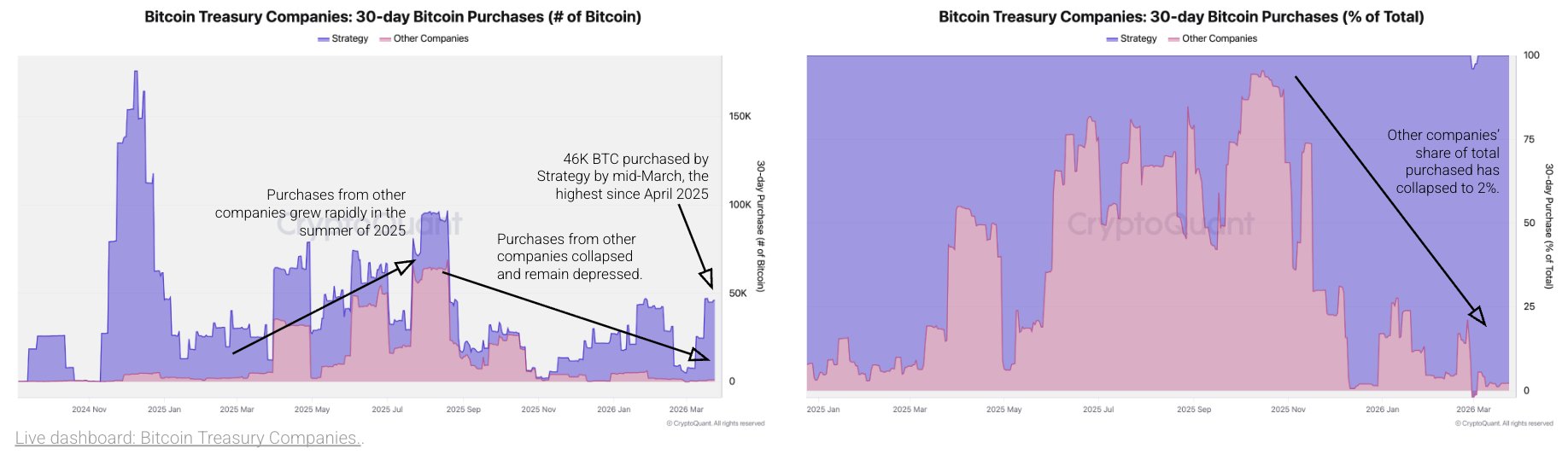
A recent CryptoQuant report has revealed that Bitcoin treasury demand is now largely dominated by Strategy, the firm led by Michael Saylor. According to the analytics firm, Strategy has purchased 45,000 BTC in the past 30 days, reflecting aggressive accumulation and the fastest growth rate in nearly a year. This represents nearly 98% of all Bitcoins purchased by corporate clients within the past 30 days.
However, during the same period, BTC purchases by other firms dropped by 99% to approximately 1,000 BTC. Their share of total BTC acquired over the past month has also declined sharply to just 2%.
Additionally, fresh demand appears to be waning, as the number of Bitcoin treasury companies making purchases has fallen to 13, down significantly from its peak of 54, indicating a lack of broad corporate participation. Instead, the overall market demand has become heavily concentrated in Strategy, whose Bitcoin holdings now account for approximately 76% of all reserve companies.
Bitcoin News: Strategy Surpasses 762,000 In BTC Holdings With Fresh $76.6M Buy
Strategy Continues Aggressive Buying Despite Market Volatility
Meanwhile, true to CryptoQuant’s analysis, Strategy, under its executive chairman, Michael Saylor, does not appear to be slowing its BTC accumulation. CoinRemark recently reported that the firm acquired an additional 1,031 BTC worth $76.6 million, despite sitting on a paper loss of $4.33 billion. Interestingly, the most recent purchase took the firm’s total bitcoin holdings to 762,099 BTC worth $57.69 billion.
The purchase came during a brief recovery in global financial markets following a temporary ceasefire in the geopolitical conflict involving the US-Israel alliance and Iran. However, markets have since reversed course amid renewed escalation in the crisis.
Bitcoin, which had climbed above $71,000, dropped sharply below $66,000 before rebounding slightly above $67,000. Market analyst Michaël van de Poppe suggests that downside risks may persist, citing elevated oil prices above $100 driven by the continued closure of the Strait of Hormuz.
According to the analyst, a sustained resolution of the conflict, alongside a breakout above $71,000, could pave the way for a bullish recovery. Until then, macroeconomic pressure and geopolitical instability remain key factors influencing Bitcoin’s price trajectory.
Michael Saylor’s Strategy Increases Bitcoin Holdings With Fresh 22,337 BTC ($1.57B) Purchase







 The CoinRemark Team
 Evans Kelvin