




Aster is entering December with a compressed market structure that could set the tone for its next major move. According to crypto market analyst Momin, the token’s latest rejection at a long-standing descending trendline underscores persistent resistance overhead.
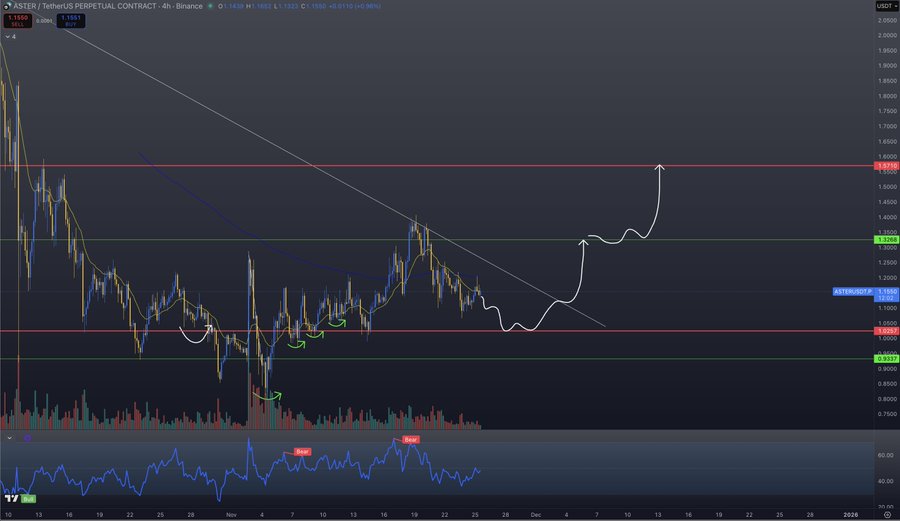
He expects the price to revisit the $1.05–$1.10 support range before any meaningful recovery attempt forms, aligning with the curved accumulation path highlighted on the recent 4-hour chart. Aster currently trades near $1.13 after incurring a 2.02% daily decline.
Additionally, the price action has tightened around a multi-week consolidation block, helping define a clearer battleground between sellers at the descending trendline and buyers defending a major accumulation zone around $1.00.
Despite short-term softness, on-chain indicators indicate a constructive demand profile. The project’s buyback dashboard confirms that $60 million has been deployed to repurchase 55.7 million ASTER shares at an average cost of $1.093.
Although no purchases occurred in the last day, the next buyback, scheduled for 10 December, could introduce fresh support. Moreover, a token burn planned for December 5 strengthens the supply dynamics heading into the month-end. Consequently, Momin declared that December could be an exciting month for Aster.
Meanwhile, analyst Crypto Patel maintains a long-term price projection of $10–$20, basing his outlook on network expansion, user uptake, and structural accumulation near the $1 zone. His chart shows repeated defenses of this level and a persistent pattern of buyers absorbing declines.
Momentum Indicators Send Mixed Market Signals
Aster’s short-term technical readings remain divided. The token recently failed to reclaim the middle Bollinger Band, now positioned at $1.188, revealing limited spot demand. Price currently tests the lower band near $1.116, a region that sometimes marks exhaustion during downward stretches.
Momentum indicators paint a similar picture. The RSI at 43.89 signals neutral conditions, leaning slightly toward oversold territory. Meanwhile, the MACD remains bearish, with both the MACD line and histogram below the signal line. These readings suggest market participants remain cautious as Aster approaches a critical support threshold.
Above price, a key breakout region sits around $2.20, identified on Crypto Patel’s projection chart. Crossing that level would signal a structural shift and potentially open the path to $3 and beyond. His visual model extends further, outlining a gradual climb to mid-range targets at $1.50 and $2.00 before accelerating toward high-value zones in later stages.
Development Roadmap Adds Long-Term Tailwinds
Fundamental drivers continue to build. Aster’s latest community roadmap confirms its L1 testnet is set for release in December, ahead of a Q1 2026 mainnet launch that introduces staking and moves the token toward a deflationary design.
Weekly liquidity pair additions, UI/UX upgrades, and new utilities aim to strengthen ecosystem depth and reinforce long-term token use. Overall, Aster’s December outlook blends tightening technical structure with key catalysts that could shape near-term volatility.







 Temitope Olajide
 The CoinRemark Team
 Evans Kelvin