




The available supply of Bitcoin on centralized exchanges has fallen to a historic low, a development that some analysts believe could amplify future price movements if demand accelerates.
Crypto analyst and early Bitcoin advocate Davinci Jeremie highlighted the trend in a recent X post, noting that the amount of Bitcoin held on exchanges has dropped to the lowest level on record. Jeremie included an accompanying Coinglass chart showing exchange balances steadily declining over time while Bitcoin’s price fluctuates, a pattern that suggests increasing accumulation and long-term holding behavior among investors.
Bitcoin Exchange Supply Shrinking
Exchange balances represent the amount of Bitcoin readily available for trading. When investors withdraw BTC from exchanges into private wallets or cold storage, those coins become less immediately accessible for sale.
The chart Jeremie shared clearly illustrates how this trend has been growing recently. Exchange-held Bitcoin has steadily declined from over 3.3 million BTC in March 2024 to roughly 2.45 million BTC, marking the lowest level recorded in years. At the same time, Bitcoin’s price has moved through several major cycles during the period shown on the chart, rising above $120,000 in October last year before pulling back into the $70,000 range.
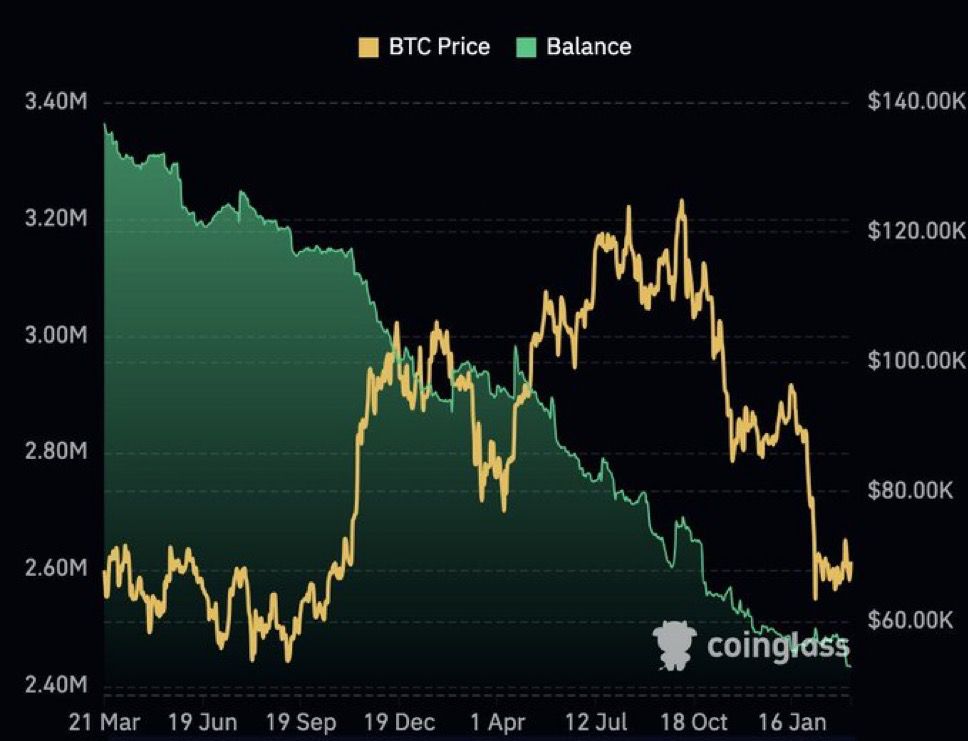
According to Jeremie, the shrinking exchange supply means there is less Bitcoin available to purchase on trading platforms, potentially tightening market liquidity if demand increases.
Supply Dynamics and Market Impact
The relationship between exchange reserves and price has become an important on-chain indicator for many analysts. When coins leave exchanges, they are often moved into long-term storage by investors who are less likely to sell in the short term. This dynamic can gradually reduce selling pressure in the market. If demand rises while the amount of tradable Bitcoin declines, the resulting imbalance between supply and demand can accelerate price increases.
Several recent on-chain developments support the broader accumulation narrative. Large institutional buyers continue adding Bitcoin to their treasuries, and corporate holders such as Strategy have steadily expanded their reserves through regular purchases.
Whale wallets have also been growing in number, with recent data showing that addresses holding 100 BTC or more are approaching the 20,000 mark, a level historically associated with accumulation phases in previous market cycles.
Long-Term Bitcoin Price Expectations
Given these tightening supply dynamics, Jeremie suggested that Bitcoin could eventually reach $500,000 if demand significantly outpaces the shrinking supply on exchanges.
While such projections remain speculative, the idea reflects a common thesis among Bitcoin supporters: that the asset’s fixed supply of 21 million coins creates powerful scarcity effects over time. Combined with increasing institutional adoption, expanding global participation, and the rise of exchange-traded funds, some analysts believe the supply-demand imbalance could intensify in future cycles.
For now, the continued decline in exchange balances highlights a key shift in Bitcoin’s market structure. More investors appear to be holding their coins off exchanges, potentially setting the stage for stronger price reactions if demand rises in the months ahead.







 Temitope Olajide
 The CoinRemark Team