




Bitcoin is once again facing obituary headlines after a fresh market downturn pushed prices below $63,000, losing key support levels. Even though the cryptocurrency is trading around $68,000, increasing volatility, weakening ETF flows, and macroeconomic uncertainty weighing on risk assets keep the obituaries alive.
As the popular crypto culture meme states, Bitcoin has been declared dead 467 times already. Yet history shows that these obituaries often coincide with moments of maximum fear rather than permanent collapse. In reality, the cryptocurrency has bounced back several times, each time stronger. In fact, if you invested $100 at each “death,” you would have $68,217,874 today.
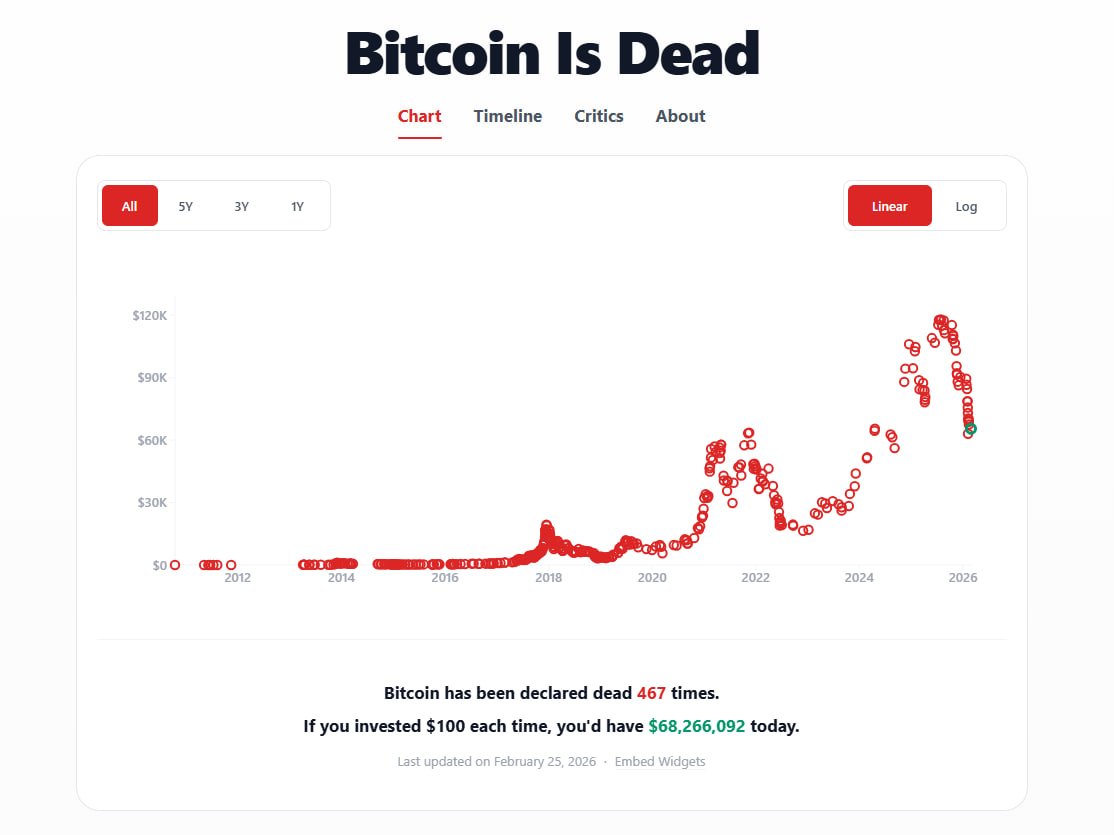
Exchange Failures and Infrastructure Shocks
Some of the loudest Bitcoin obituaries followed major exchange failures. In 2014, the collapse of Mt. Gox, which at the time handled 70% of global Bitcoin trading volume, sent prices tumbling from its late-2013 peak near $1,160 to below $400, eventually bottoming near $200 in early 2015. Confidence in the ecosystem appeared shattered. However, Bitcoin gradually recovered and surged to nearly $20,000 by December 2017.
A similar pattern unfolded in November 2022 when FTX collapsed. Bitcoin dropped from a late-2021 peak of $69,000 to roughly $15,500, marking a two-year low. Once again, critics questioned whether the broader crypto market could survive another systemic failure. Yet in the following cycle, Bitcoin stabilized, regained momentum, and eventually pushed to a new all-time high of $126,200, driven by spot ETF approvals and institutional inflows.
In both cases, the crisis centered on centralized intermediaries rather than Bitcoin’s underlying protocol. The exchange infrastructure failed, but the Bitcoin network survived and continued operating without interruption, rebounding eightfold.
Regulatory and Global Liquidity Crises Tested Bitcoin
Regulatory crackdowns and macroeconomic shocks have also triggered Bitcoin’s obituary cycles. In 2017, China intensified restrictions on cryptocurrency exchanges and mining operations. As a result, Bitcoin fell sharply from around $5,000 in August to near $3,000 within weeks. Predictions of collapse spread quickly. Instead of fading, Bitcoin rebounded more than sixfold, reaching nearly $20,000 by December.
The COVID-19 market crash in March 2020 delivered another severe test. As global markets spiraled amid pandemic fears, Bitcoin plunged nearly 50% in a matter of days. The price collapsed from roughly $8,000 to below $4,000 during what became known as “Black Thursday.” The drop mirrored broader financial market turmoil. Liquidity evaporated, leveraged positions were liquidated, and skeptics once again declared the end. Within a year, however, Bitcoin had rallied past $60,000, fueled by stimulus measures and rising institutional interest.
These episodes outline how external pressures, such as regulatory shifts or global crises, have triggered dramatic Bitcoin drawdowns in the past. Yet, none permanently derailed Bitcoin’s long-term adoption.
The Current Bitcoin Downturn in Context
Today’s environment shares elements of past cycles. Bitcoin is down 48% from its all-time high just five months ago and recently slipped below $63,000 amid weaker ETF inflows, cautious investor sentiment, and broader risk-off conditions in global markets. Unlike previous collapses, there is no single exchange failure or protocol breakdown driving the decline. Instead, the weakness reflects cyclical contraction following a strong rally earlier in the cycle.
Throughout its history, Bitcoin has endured drawdowns exceeding 50% on multiple occasions. Each episode prompted predictions of permanent decline. Each was followed by recovery in subsequent cycles.
Now, this historical resilience does not necessarily guarantee future outcomes. Markets evolve, and macro conditions shift. However, the repeated pattern of crisis, capitulation, and recovery remains one of Bitcoin’s defining characteristics.
As the market stabilizes above $68,000, the latest round of obituaries is not novel; they are more like another chapter in a cycle that has defined Bitcoin for over a decade.






 Temitope Olajide
 The CoinRemark Team