



The second quarter of 2026 delivered mixed results for crypto airdrop projects. While some tokens gained significant value after their token generation events (TGEs), others struggled to maintain investor interest.
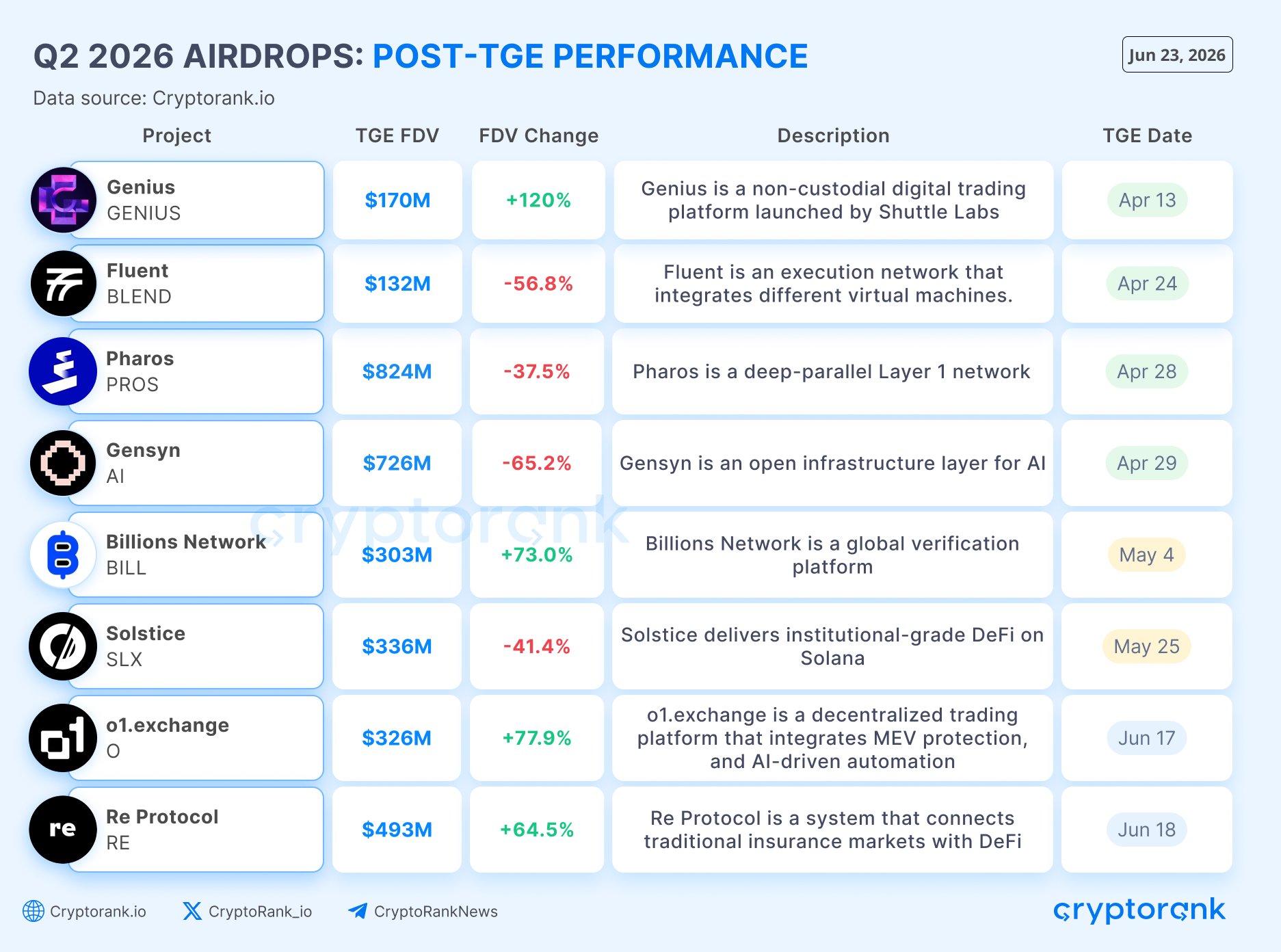
In a fresh update, CryptoRank data shows that only four of the eight airdrop projects tracked in Q2 2026 increased their fully diluted valuation (FDV) after launch. The remaining four projects recorded notable declines, highlighting the mixed fortunes and risks that often follow token distributions.
Genius Leads the Top Performers
Genius (GENIUS) emerged as the strongest performer among Q2 airdrop projects. The token recorded a 120% increase in FDV after its TGE, making it the clear leader of the group. Interestingly, GENIUS is the native token of Genius Terminal, a non-custodial DeFi trading platform.
The project distributed the airdrop as a reward for BNB holders and other users within the Genius ecosystem. The GENIUS token debuted on Binance Alpha on April 13, 2026. On the same day, the platform launched a 70-million-token airdrop campaign. Eligible participants could either claim their tokens immediately and accept a 70% burn penalty or lock their allocation for one year to receive the full amount.
Meanwhile, aside from GENIUS, several other tokens also posted impressive gains. O1 Exchange secured the second spot with a 77.9% increase in valuation. Interestingly, the platform’s native O token went live on June 17, 2026, and its airdrop also launched on the same day. Coming next was Billions Network, which posted a 73.0% gain. Rounding out the list of top performers was Re Protocol, which rose 64.5% after its TGE on June 18, 2026.
Gensyn and Fluent Suffer Heavy Losses
However, not all projects enjoyed the same success. Several tokens lost a large portion of their value after their TGEs. Topping the losers’ list was Gensyn AI, which recorded a 65.2% decline in FDV after launch. Interestingly, Gensyn is an open infrastructure layer designed for artificial intelligence applications. It is also worth noting that the platform distributed its token airdrop in two major phases.
The first phase launched on April 29, 2026, as a Binance Alpha airdrop. Only users with at least 227 Alpha Points were eligible to claim 715 AIGENSYNS tokens. The second phase ran from May 4 to May 6, 2026. During this period, only BNB holders who subscribed their assets to Binance Simple Earn or On-Chain Yield products qualified for the reward distribution.
Meanwhile, Fluent’s native token, BLEND, ranked second-worst among the tracked projects. The token posted a 56.8% decline in FDV after its TGE. It is worth noting that Fluent is an execution network that integrates multiple virtual machines into a single environment. The project aims to improve blockchain interoperability and developer flexibility across different ecosystems.
Interestingly, Fluent’s airdrop went live on April 24, 2026, following the official launch of its mainnet and the BLEND token generation event. To participate, users had to register through the project’s airdrop portal. Echo sale participants and users who completed testnet activities were eligible to register their wallets on the Fluent mainnet and receive BLEND token allocations.
Others also appeared among the list of underperforming airdrop projects. Solstice recorded a 41.4% decline in FDV following its TGE, ranking among the quarter’s biggest losers. Rounding out the list was Pharos, which posted a 37.5% drop in FDV after launch. The result means that four of the eight tracked airdrop projects ended the quarter with valuations lower than at their TGEs, highlighting the mixed performance recorded across Q2 2026.





 The CoinRemark Team
 Evans Kelvin