



A key stablecoin metric has flashed a rare signal that previously appeared only at the depths of the 2022 Bitcoin bear market, according to CryptoQuant analyst MorenoDV.
In a recent analysis, the analyst noted that USDT’s 60-day market cap change has fallen below $3 billion, printing less than $1 billion in single-day outflows three times in this period. This means that over the past 60 days, Tether’s total market value has shrunk by more than $3 billion, a sharp reversal from the expansion typically seen during bullish phases.
According to CryptoQuant data, this level has only been reached once before, in late 2022, when Bitcoin was carving out its cycle bottom near $16,000 amid widespread capitulation and forced selling.
What the 60-Day Market Cap Change Means
The 60-day market cap change measures how much USDT’s total supply has increased or decreased compared to two months prior. When the metric is positive, it signals that new USDT is being minted and entering the market, often providing additional liquidity for traders to deploy into Bitcoin and other crypto assets.
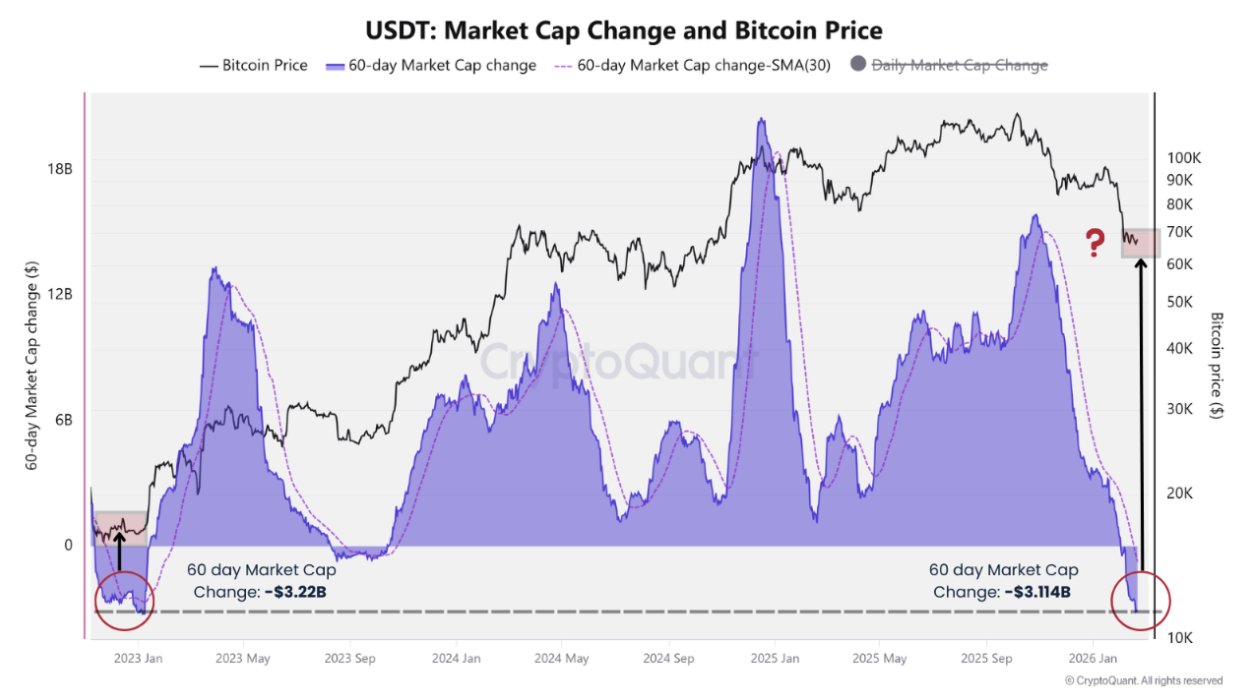
When it turns sharply negative, however, it suggests stablecoin redemptions or reduced issuance. In simple terms, there is less fresh capital flowing into the market. Since USDT is the largest stablecoin and a primary trading pair across exchanges, changes in its supply are closely watched as a proxy for overall market liquidity.
Bitcoin Whales Spring To Action With 30,000 BTC Accumulation Despite Weak Market Sentiment
Similar Bitcoin and Macro Environments
The previous time this signal appeared, Bitcoin was trading near $16,000 after months of heavy selling triggered by major industry failures and macroeconomic tightening. The negative USDT supply shift coincided with extreme fear and ultimately preceded a long recovery phase.
This time, the signal is emerging with Bitcoin trading between $65,000 and $70,000 following a prior all-time high run. Bitcoin’s latest dip below $65,000 on Sunday underscores the similarities between both time periods and market environments. Sinking macroeconomics have pushed the market deeper into a bearish phase with participants watching for the next source of respite.
The contraction in stablecoin supply signals growing caution among traders. Reduced USDT growth could suggest that capital is moving to the sidelines rather than being deployed into the crypto market. This could limit buying power across exchanges, thus increasing downside pressure if selling accelerates.
Historical Context
However, the signal does not automatically imply a market crash. In 2022, when the metric marked a similar period of maximum fear, a strong medium-term recovery followed as the Bitcoin price almost doubled by March 2023.
Traders and investors are now closely monitoring whether USDT supply continues to shrink or stabilizes in the coming weeks. A return to positive growth would signal renewed confidence and fresh capital entering the market. Continued contraction, on the other hand, may reinforce caution.
Strategy Chairman Saylor Predicts Swift Bitcoin Rebound Amid ‘Mild Crypto Winter’







 Temitope Olajide
 Josiah Oluwadare
 The CoinRemark Team