


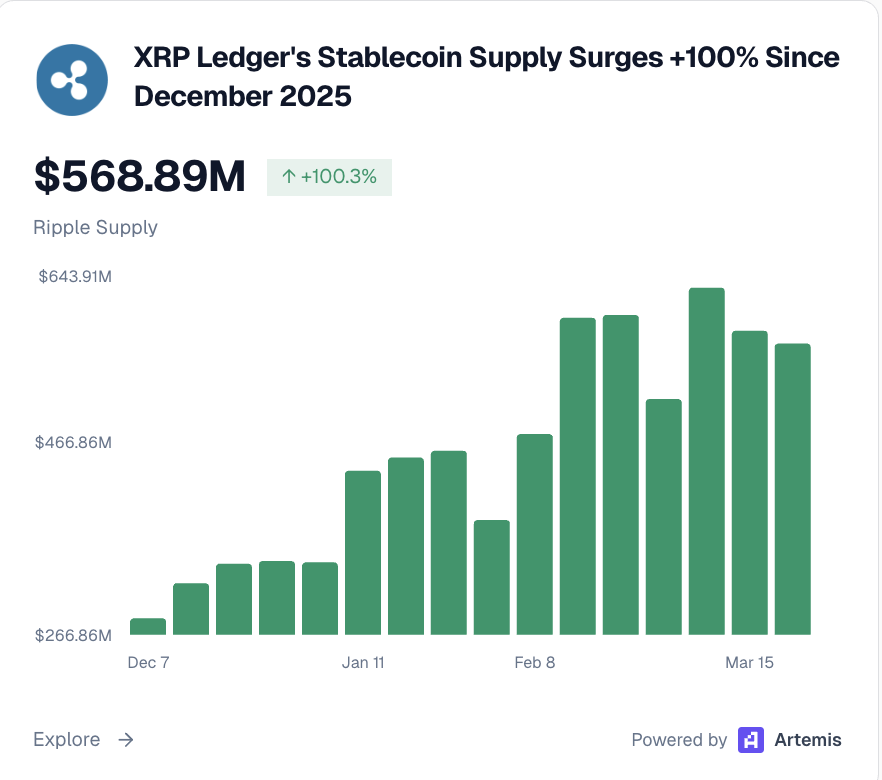
The XRP Ledger is seeing a sharp rise in stablecoin activity, according to data from on-chain analytics firm Artemis. Recent figures show stablecoin supply on XRPL climbing to approximately $568.89 million, marking a significant jump in just a few months. This represents an over 100% surge from about $266.86 million in December 2025, reflecting increasing usage of the network for payments, liquidity, and on-chain financial activity.
XRP Ledger Reaches 13-year Milestone Amid XRP Price Recovery
XRP Ledger Expands Its Financial Infrastructure Role
The milestone comes as XRPL strengthens its position as a financial infrastructure layer rather than just a payments network. Recent developments reinforce this shift. The network recently surpassed 7.7 million holders, alongside a surge in active addresses. This further signals the growing real-world usage of the XRP Ledger.
Similarly, Ripple’s stablecoin ecosystem is expanding rapidly. Its USD-backed stablecoin, RLUSD, has already grown to over $1.5 billion in market capitalization. The stablecoin’s recent integrations with major financial institutions and payment infrastructure are the major drivers of this expansion. Additionally, regulated stablecoins such as AUD- and EUR-denominated assets, are being deployed directly on the ledger.
Beyond stablecoins, the XRP Ledger is also seeing increased adoption in tokenized assets and institutional finance. Over $1.3 billion in tokenized assets have recently been added to the network, highlighting its growing role in real-world asset (RWA) markets and cross-border settlement systems.
Together, these developments point to a broader transformation on the blockchain. The XRP Ledger is evolving into a hub for liquidity, tokenization, and institutional-grade financial activity, with stablecoins acting as the primary gateway for capital entering the ecosystem.
Stablecoin Growth Signals Rising Global Utility
Stablecoins are a core component of blockchain ecosystems. They serve as the primary medium for trading, payments, and settlement. A sharp increase in their supply typically signals growing demand for on-chain liquidity.
On XRPL, this expansion suggests that more users and institutions may be leveraging the network for real-world financial use cases, including cross-border transactions and digital payments. This is especially true as recent geopolitical tensions disrupted traditional financial activities and pushed many financial activities on-chain. That event highlighted blockchain’s accelerating role in global financial activity.
The broader crypto market has recently experienced increased volatility, prompting both retail and institutional participants to seek stable, dollar-denominated assets for liquidity management. As a result, stablecoins have seen rising demand across multiple blockchains, and XRPL is capturing a large portion of that flow.
While stablecoin growth does not directly translate to immediate price movement, it can have indirect implications for the XRP price. Higher on-chain liquidity and increased usage can strengthen network fundamentals. This, in turn, could support long-term adoption and demand for XRP as a bridge asset within the system.





 Temitope Olajide
 The CoinRemark Team