




Crypto investment products recorded outflows over the past week, with $414 million leaving the market as a combination of geopolitical tensions, inflation fears, and shifting Federal Reserve rate expectations triggered a broad risk-off response from institutional investors. Notably, this marks the first weekly outflow in five weeks, signaling a pause in the recent streak of inflows into digital asset funds.
According to a recent CoinShares report, total assets under management fell to $129 billion, revisiting levels last seen in early February and broadly comparable to April 2025 during the initial phase of Trump’s tariffs.
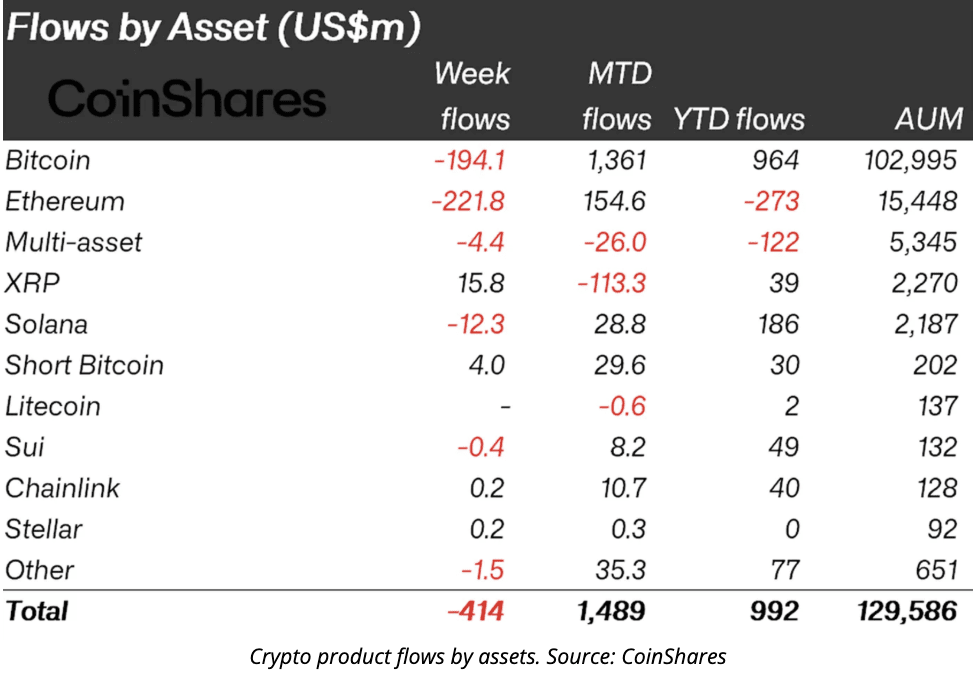
Ethereum bore the most brunt of the negative sentiment, recording $222 million in outflows and pushing YTD flows to a net outflow position of $273 million, the worst of any digital asset. The exit across Ethereum products was amplified by withdrawals from spot ETH ETFs, which posted $206.6 million in outflows for a second consecutive week.
Bitcoin also saw outflows totalling $194 million, but it remains in a net inflow position year-to-date of $964 million. As for altcoins, the inflows are mixed as Solana recorded $12.3 million in outflows, while XRP stood out as one of the only assets with positive weekly flows at $15.8 million. Chainlink and Stellar also recorded modest inflows of $0.2 million each.
Reason Behind Recent Losses
For context, investors reacted to the increasingly drawn-out nature of the Iran conflict and the prospect of higher inflation, with June FOMC interest rate expectations having flipped from rate cuts to rate hikes.
The shift marks a notable change in the macro backdrop that had supported five consecutive weeks of crypto fund inflows earlier this month. Spot Bitcoin ETFs posted $296 million in outflows, snapping a four-week inflow streak that had brought in over $2.2 billion.
Regional Flows
The negative sentiment was almost solely concentrated in the US, which recorded $445 million in outflows. Minor outflows of $4 million were also seen in Switzerland. Conversely, German and Canadian investors treated the price weakness as a buying opportunity, with inflows of $21.2 million and $15.9 million respectively.
Investors are currently navigating a “perfect storm” of headwinds. On the one hand, geopolitical conflict in Iran has driven oil prices higher, stoking fears of renewed inflation. On the other, the Federal Reserve’s March meeting resulted in interest rates being held steady at the 3.5%–3.75% range. Crucially, market expectations for June have flipped from anticipated rate cuts to potential rate hikes as the Cleveland Fed’s “Inflation Nowcasting” tool predicts a jump in CPI.






 Evans Kelvin