


Stablecoin liquidity is quietly rebuilding across the crypto market, with reserves on Binance climbing sharply in recent sessions. While this does not immediately translate into a price rally, it signals that significant capital is repositioning on the sidelines, often a precursor to major market moves.
CryptoQuant Flags Rapid Growth in Binance Stablecoin Reserves
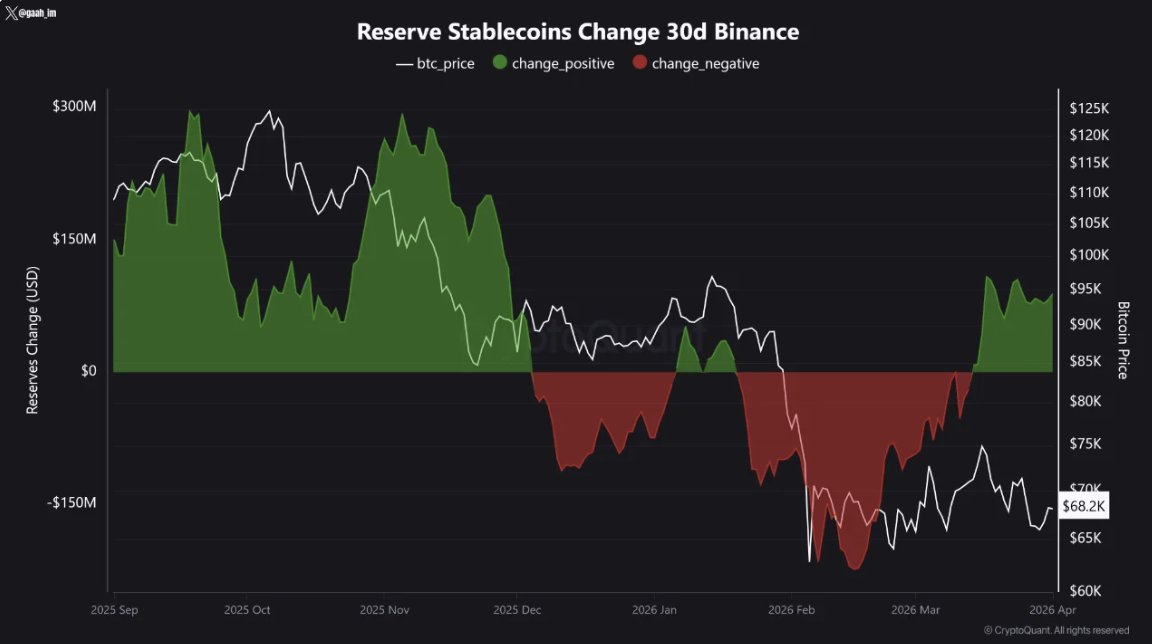
A recent report by CryptoQuant analyst Gaah revealed that stablecoin reserves on the Binance exchange are rapidly growing. Using supporting chart data, the analyst showed that steady inflows have pushed reserves to levels not seen since December 2025, underscoring a notable return of liquidity into the market.
In practical terms, rising stablecoin reserves enhance the market’s ability to absorb sell-side pressure. Traders and institutions holding stablecoins are effectively positioned on the sidelines, ready to deploy capital when favorable conditions emerge. This creates a buffer against sharp downturns while simultaneously laying the groundwork for potential upward momentum
It also reflects a more cautious but prepared market structure, where participants are waiting for confirmation before committing to directional bets. Interestingly, Lookonchain recently reported that stablecoin giant Circle has minted 3 billion USDC over the past 4 days, minting it in batches of 750 million per day on the Solana network.
Meanwhile, Gaah further emphasized that this recent capital surge is unlikely to remain idle. Instead, the analyst speculated that the liquidity is actively flowing into the market to fill limit orders across key price levels. According to Gaah, this setup is historically associated with periods preceding a spike in volatility, as clustered orders can trigger rapid price expansions once key levels are breached.
Geopolitical Shock Deepens Market Uncertainty
Meanwhile, this increase in liquidity comes shortly after U.S. President Donald Trump announced that the United States would intensify its attacks on Iran, abruptly disrupting market sentiment and invalidating hopes of a swift de-escalation in the conflict. The announcement injected fresh uncertainty into already fragile global markets.
In the immediate aftermath, global financial markets plunged into turmoil, with U.S. equities experiencing widespread liquidations that erased millions of dollars in value in a short period. The crypto market was not spared. Bitcoin, which had recently recovered toward $69,000, quickly reversed course and fell below $66,000 as risk appetite deteriorated.
The situation was further compounded by a sharp surge in oil prices into triple-digit territory, driven by the effective closure of the Strait of Hormuz, a key artery for global energy supply. Adding to the uncertainty, the United Nations Security Council blocked an Arab-backed resolution aimed at reopening the waterway through force, with opposition from Russia, France, and China.
Amid these bearish conditions, a separate analysis by CryptoQuant-linked XWIN Research Japan suggests a severe downside scenario. According to the report, if the current situation persists and the waterway remains closed for an extended period, Bitcoin could potentially decline to as low as $10,000. However, according to CoinMarketCap, Bitcoin is up 0.2% over the past 24 hours, trading near $67,000, suggesting the market is still attempting to stabilize despite mounting macroeconomic pressure.




 The CoinRemark Team
 Evans Kelvin