




The Bitcoin market structure is undergoing a notable transformation, with new on-chain data indicating tighter supply conditions. A sharp decline in wholecoiner activity suggests sell-side pressure is easing, potentially reinforcing the concept that the recent BTC rally to $75,000 may not be a fluke.
Bitcoin Wholecoiner Flows Drop Sharply
According to CryptoQuant analyst Darkfost, Bitcoin’s wholecoiner flows across exchanges have dropped drastically in recent months. For context, wholecoiners are investors holding at least 1 BTC, a set that is increasingly rare due to Bitcoin’s continuous price appreciation.
Darkfost explains that as Bitcoin grows more expensive, accumulating a full coin becomes significantly harder for new entrants, gradually shrinking this category of holders. This structural change is now reflected clearly in exchange flow data.
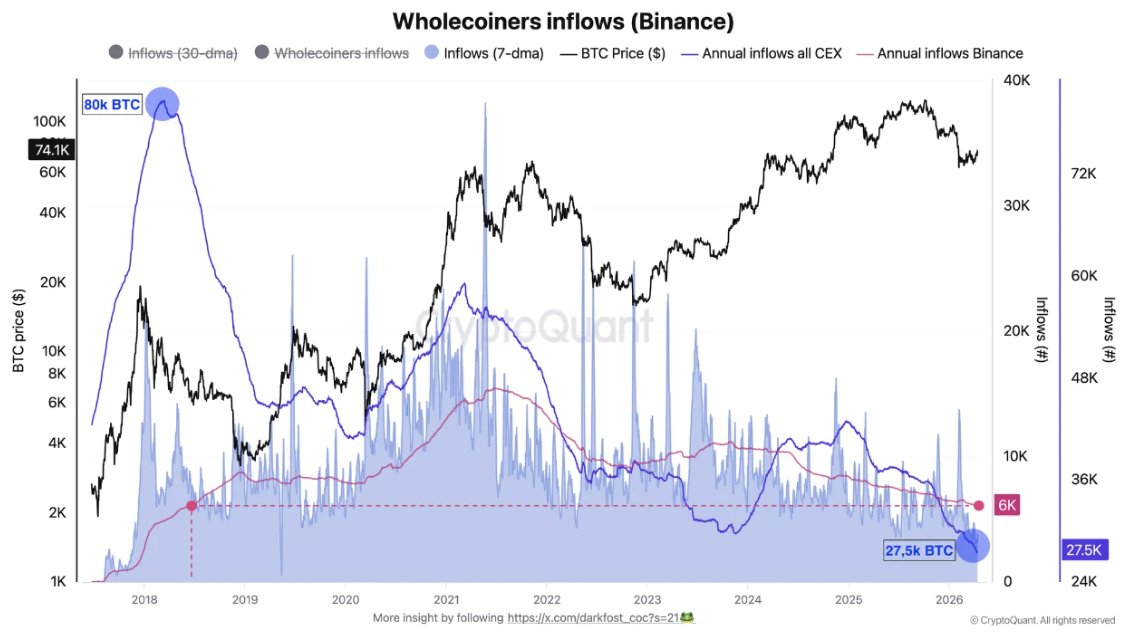
On Binance, the world’s largest crypto exchange by trading volume, the monthly average of wholecoiner flows has declined to around 6,000 BTC. Notably, this level is comparable to 2018 figures but remains far below the peak of 15,400 BTC recorded during the 2021 bull cycle.
However, on a broader scale, the decline is even more pronounced. Global wholecoiner transfers have dropped to roughly 27,500 BTC, a steep fall from the 80,000 BTC peak observed in 2018. This sharp contraction underscores a significant reduction in movement and likely selling by large holders.
Reduced Bitcoin Exchange Dependence
Meanwhile, Darkfost claims that the drop in wholecoiner flows also signals a deeper structural shift in how Bitcoin is held and traded. Investors are increasingly moving away from centralized exchanges and toward cold storage or institutional-grade custodial solutions.
The rise of spot Bitcoin ETFs and other investment vehicles, which offer exposure without direct on-chain movement, partly drives this trend. Consequently, exchange inflows are no longer the sole indicator of market intent, as significant capital now flows through off-exchange channels.
As more BTC becomes locked in long-term holdings, the liquid supply available on exchanges continues to shrink, tightening overall market liquidity.
Supply Shock Dynamics Strengthen Case for Rally Beyond $75,000
The combination of declining exchange flows and increasing illiquidity is setting the stage for a potential supply shock. When fewer coins are readily available for trading, even moderate demand surges can trigger outsized price movements.
This evolving dynamic strengthens the case for a sustained move towards $75,000 and beyond. Notably, BTC recently rallied above the $75,000 mark but faced rejection and slipped back to the $74,000 region, signaling near-term resistance. However, macro economist Michael van de Poppe stated in a recent post on X that Bitcoin may be setting up for a short squeeze, describing the recent rejection as a minor correction rather than a trend reversal.
According to him, BTC could soon break out toward $86,000, where it would encounter another key resistance zone. That said, this bullish scenario hinges on the asset maintaining support above $72,000, a critical threshold for sustaining upward momentum. If these conditions hold, the current tightening supply environment could act as a catalyst for the next leg higher in Bitcoin’s ongoing rally.







 The CoinRemark Team
 Evans Kelvin