


Ethereum has recorded its busiest quarter in history during Q1 2026. According to Artemis Analytics, the network processed over 200 million transactions last quarter. The milestone marks the first time the network has surpassed 200 million in a single quarter, highlighting a sharp recovery in on-chain activity.
The figure represents a 43% increase from Q4 2025, when the network processed approximately 145 million transactions, continuing a steady upward trend that began in mid-2025. It also reflects a broader rebound from 2023 lows, when quarterly activity dipped to around 90 million. Since then, Ethereum has completed a multi-year recovery in network usage.
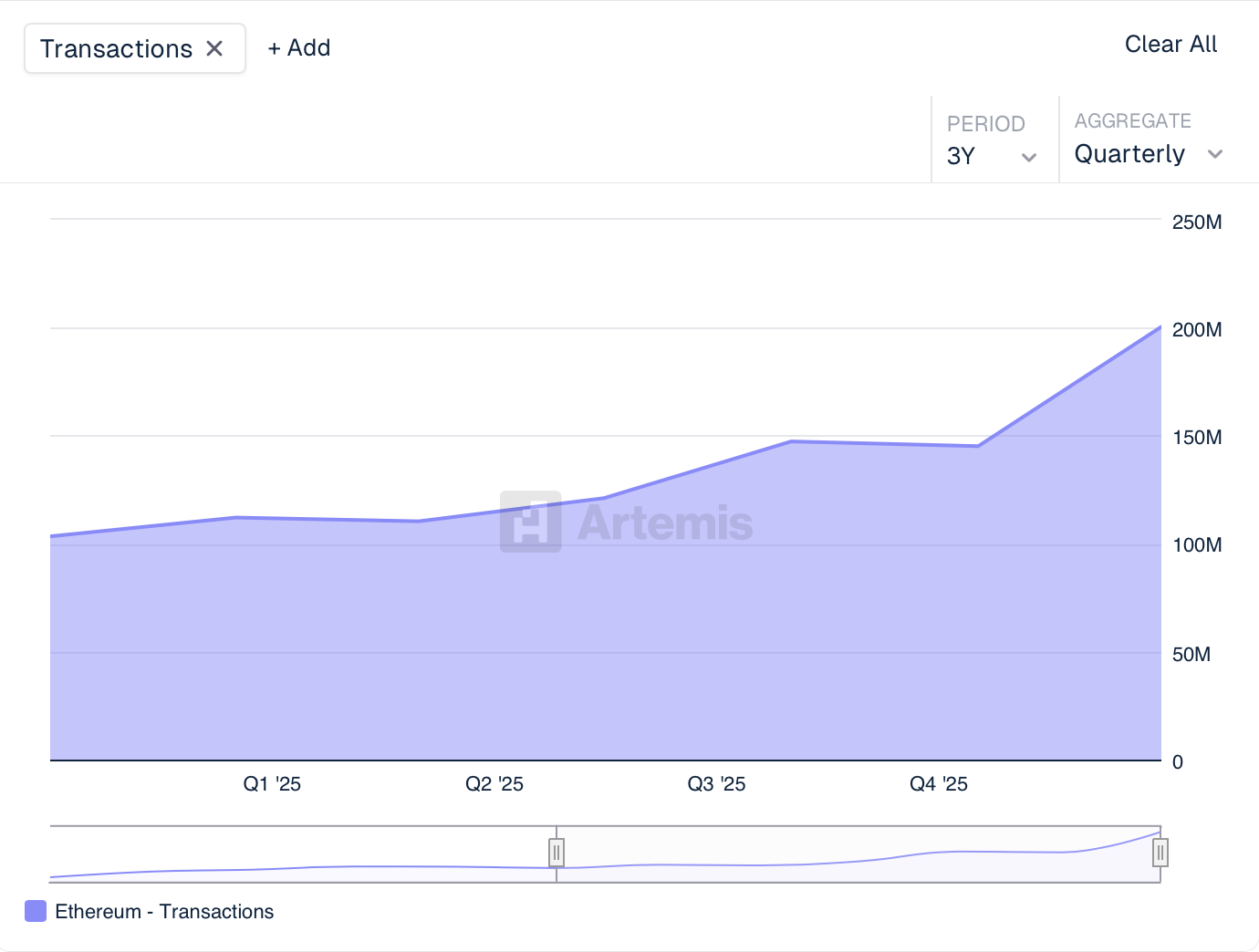
Data shows that transaction counts have steadily climbed through 2024 and 2025, culminating in the record-breaking Q1 2026 performance. The increase signals renewed demand across Ethereum’s ecosystem, even as market conditions remain volatile.
Layer 2 Growth and Stablecoins Drive Demand on Ethereum
The growth in activity mostly came from layer 2 scaling networks and stablecoin usage. Layer 2 networks built on the Ethereum framework ultimately batch down their activity on Ethereum’s mainnet. For instance, networks such as Base and Arbitrum allow users to transact at lower cost, and their activity appears on Ethereum’s mainnet as bridging and settlement.
At the same time, stablecoin adoption on Ethereum has expanded significantly. According to data from TokenTerminal, the total stablecoin supply on the network has reached around $180 billion. That amounts to roughly 60% of the global stablecoin market.
These two factors have combined to drive higher transaction volumes, even when users are not directly interacting with Ethereum’s base layer.
Price Lags Behind Network Fundamentals
Despite the surge in activity, Ethereum’s price has not kept pace with its on-chain growth. At the time of writing, Ethereum traded at $2,399, marking an 8% increase over last week’s price. Yet the asset remains 52% below its all-time high of $4,953 set in August 2025. This creates a noticeable divergence between network usage and market valuation.
This gap suggests that while Ethereum’s fundamentals are strengthening, the market has yet to fully reflect that growth. Analysts often view such divergences as potential indicators of future price movements, particularly when sustained activity continues.
This could be because structural changes, such as reduced data costs for layer 2 networks, have altered how value is captured. Increased activity no longer translates directly into higher fees or token burn. Given this shift in Ethereum’s economic model, the increased activity would not necessarily translate into a higher valuation.
Nevertheless, the record also highlights Ethereum’s evolving role as a settlement layer for a broader ecosystem. Rather than focusing solely on raw transaction volume, the network continues to anchor high-value activity, including decentralized finance and institutional flows.




 The CoinRemark Team
 Evans Kelvin