
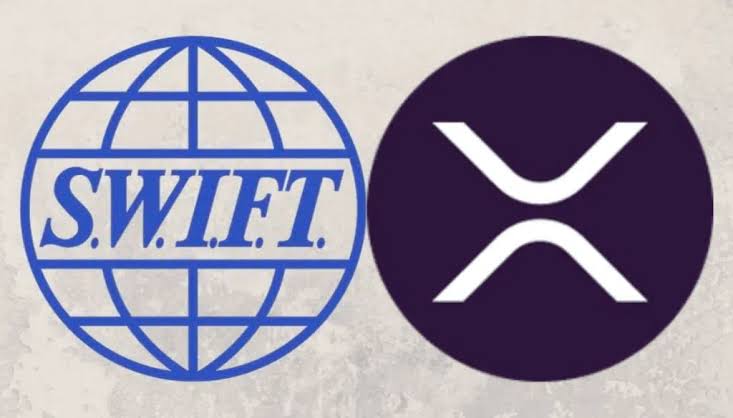
A fresh wave of bullish commentary is circulating across the crypto market, linking XRP with the global banking network SWIFT. The narrative suggests that a potential integration between the two could significantly reshape global payments and elevate XRP’s role in cross-border finance. While the discussion is gaining traction among retail investors, it remains highly speculative and lacks confirmed institutional developments.
XRP-SWIFT Integration: Theory Gains Momentum
In a recent X post, market expert The Real Remi Relief, citing projections from Google’s Gemini, speculated that XRP could surge to $1,500–$2,000 if it captures 50% of SWIFT’s transaction volume, with projections doubling to $3,000–$4,000 under full adoption. According to the analyst, such price expansion would be necessary to prevent slippage during high-value transfers.
SWIFT currently processes over $5 trillion in daily transactions. If XRP were to handle 50% of that volume, approximately $2.5 trillion per day, it would translate to an annualized flow of roughly $912.5 trillion. Under this framework, Gemini argues that XRP would need to maintain around 10% of that daily volume in available liquidity.
This requirement, in theory, could push its valuation toward the $1,600 level to sustain efficient settlement conditions. The commentator further emphasized that this projection is based solely on SWIFT-related flows. Beyond that scope, the analysis maintains that the token could ultimately reach $10,000 if broader financial systems integrate the asset at scale.
Ripple Expands Footprint in Brazil With Broader Crypto and Payment Services Rollout
Messaging vs. Settlement Dynamics
Meanwhile, the Society for Worldwide Interbank Financial Telecommunications (SWIFT) is a secure global messaging network that enables financial institutions to send and receive payment instructions for international transfers. Currently, SWIFT connects over 11,000 financial institutions worldwide, including major banks and payment providers.
In contrast, XRP functions as a fast, blockchain-based settlement layer that executes transactions in approximately 3–5 seconds at very low cost. This efficiency is enabled through Ripple’s Ripple Payment solution, which removes the need for pre-funded nostro accounts by using XRP and RLUSD as bridge assets between fiat currencies.
However, while SWIFT is highly secure and deeply entrenched, it typically processes transactions within 1–5 business days. As a result, some financial institutions have begun exploring blockchain alternatives, such as XRP, to enhance settlement speeds.
That said, adoption is not a full replacement scenario. Instead, a hybrid model is emerging, where institutions use SWIFT for standardized messaging while leveraging XRP or blockchain rails for settlement. SWIFT itself has explored distributed ledger technologies in recent years, including interoperability testing with blockchain systems.
On the corporate side, Ripple made a strategic expansion move in 2025 by acquiring GTreasury. Following the deal, Ripple broadened its infrastructure to support SWIFT-connected banks, allowing them to choose between traditional rails and blockchain-based settlement using XRP or RLUSD, its network stablecoin.
Ripple CEO Brad Garlinghouse Fires Back at Avalanche’s April Fool’s Dig at Ripple




 The CoinRemark Team
 Evans Kelvin