

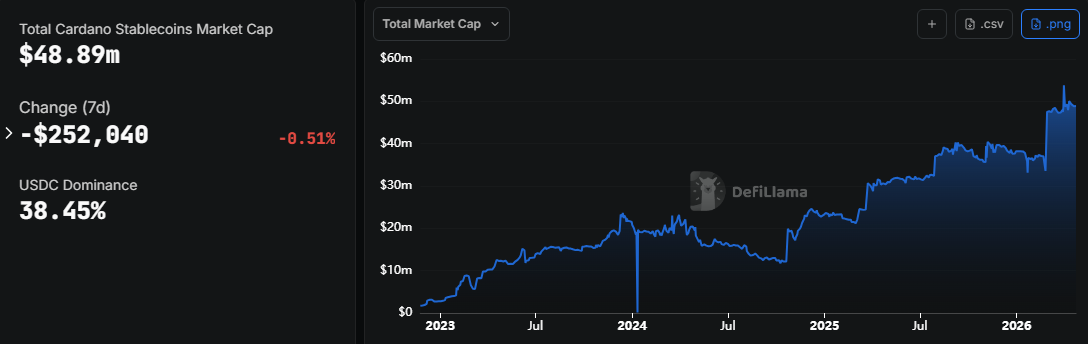
Stablecoin market on the Cardano network has expanded rapidly over the past year, according to DeFiLlama data. Total stablecoin supply on the network rose from around $30 million in April 2025 to roughly $48.9 million in 2026, representing a surge of 63% over the past year. The sharp increase reflects more than just new issuance. It signals a shift in how liquidity is being deployed across the network.
The growth has coincided with rising activity across Cardano’s decentralized finance ecosystem. Notably, stablecoins are increasingly being deployed for trading, lending, and liquidity provision rather than remaining idle.
Stablecoin Growth on Cardano Tied to DeFi Expansion
A major catalyst behind the surge has been the introduction of Circle’s privacy stablecoin, USDCx. That integration brought a significant influx of liquidity into the ecosystem, as stablecoin supply climbed from roughly $30 million to over $47 million within weeks. Till date, that development marks one of the fastest expansions in Cardano’s on-chain capital base.
This liquidity has not remained static. According to a recent report from Charles Hoskinson’s Input Output Group, the total value locked across Cardano protocols rose from approximately $127 million to $142 million following the influx. The report also revealed that individual protocols grew, with Minswap and SundaeSwap posting notable increases in locked value.
The rise in stablecoin supply has also been sponsored by a measurable increase in on-chain activity. On the lending side, over $3 million worth of USDCx has already been supplied to Liqwid. Decentralized exchange activity has also picked up alongside the influx of liquidity. Key pools such as NIGHT/USDCx (about $6.6 million) and USDCx/USDM (about $5.3 million) support consistent trading activity across the network.
This pushed Cardano’s decentralized exchange volume to approximately $2 million daily and about $7 million weekly. While still modest compared to larger ecosystems, the figures point to sustained usage rather than isolated spikes. Stablecoins are now actively powering trading pairs, improving liquidity depth and enabling smoother execution across platforms.
New Capital Flows Into the Ecosystem
The expansion has also been supported by cross-chain inflows. Input Output’s data shows over 6,100 bridge transactions, with approximately $1.17 million in user-driven inflows entering the network. Early activity averaged around $338,000 in daily inflows, indicating steady capital movement.
Cardano’s surging stablecoin market share is the result of three converging factors: rapid supply expansion, increasing DeFi usage, and consistent liquidity inflows. These shifts mean stablecoins now account for a significantly larger portion of the network’s on-chain activity.
Despite the growth, the ecosystem remains in its early stages. Cardano’s total value locked still sits around the $130 million range, ranking 25th among other chains. Decentralized exchange volumes remain relatively low compared to more established networks. Nevertheless, Cardano will continue to invest in its DeFi layer, and we may come to see increased activity into the future.






 The CoinRemark Team
 Evans Kelvin