



In the latest crypto news, crypto asset manager Bitwise has revealed how Wall Street’s relationship with Bitcoin is rapidly evolving. The firm revealed in its latest X post that Bitcoin exchange-traded products (ETPs) are steadily entering mainstream U.S. wealth management channels.
Using a chart, Bitwise categorized major U.S. wealth platforms into three groups based on how they currently handle access to Bitcoin ETPs: Restricted, Unsolicited Only, and Solicited. The data showed that more firms, including Morgan Stanley, Fidelity, Charles Schwab, Bank of America, Wells Fargo, Vanguard, and State Street, now fall under the Solicited category. This means that financial advisors at those firms can actively recommend Bitcoin ETPs to clients.
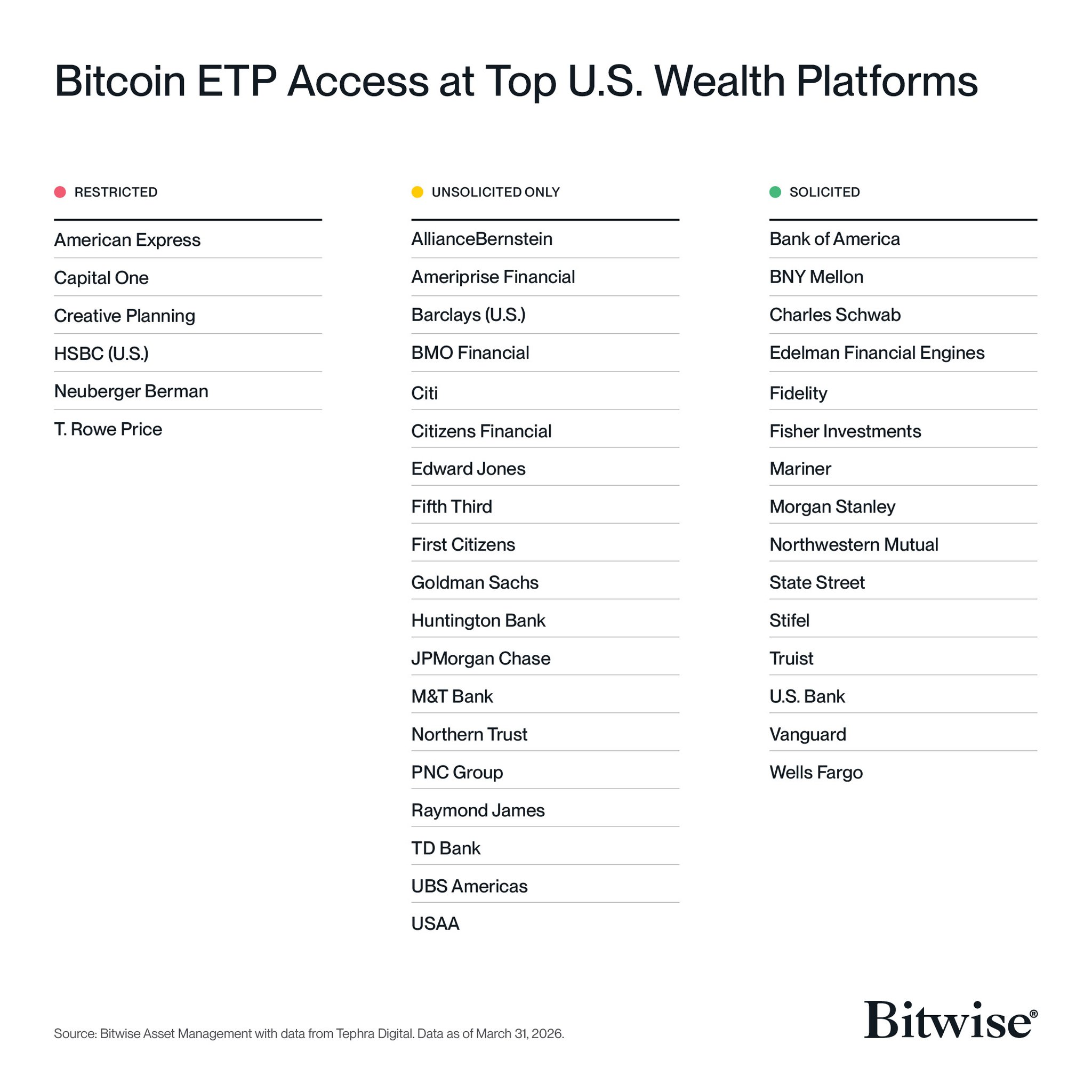
Meanwhile, institutions such as JPMorgan Chase, Goldman Sachs, Citigroup, UBS, and Raymond James remain under “unsolicited only.” These firms grant access only when clients specifically request exposure. Additionally, a smaller group of firms, including HSBC, T. Rowe Price, and American Express, still maintains restrictive policies toward Bitcoin ETP access.
Why the Solicited Category’s Expansion Matters
For years, Bitcoin exposure largely remained outside traditional portfolio construction frameworks, requiring investors to use crypto exchanges or self-custody solutions. The rise of spot Bitcoin ETFs and ETPs has dramatically changed that dynamic.
Since the approval of spot Bitcoin ETFs in the United States in 2024, institutional participation in crypto has accelerated. Products such as BlackRock’s IBIT, Fidelity’s FBTC, and Bitwise’s BITB have attracted billions in inflows. They have also made Bitcoin exposure accessible through standard brokerage accounts and retirement portfolios.
The growing number of wealth advisors incorporating Bitcoin ETPs is also significant, as they collectively oversee trillions of dollars in client capital. Institutional analysts say advisor recommendations could become one of the biggest catalysts for long-term Bitcoin adoption. This is especially true as traditional investors grow more comfortable with regulated crypto investment products.
The development is also being catalyzed by the parallel discourse around crypto regulation efforts. The CLARITY Act has seen recent breakthroughs, and a new draft is currently under review ahead of Thursday’s markup. As the potential for legislation in the space increases, institutions are positioning for crypto use in a regulatory-favorable environment.
Wall Street’s Bitcoin Narrative Has Changed
Bitwise’s latest data also reflects a broader transformation taking place across Wall Street. Major banks and financial institutions that once publicly questioned Bitcoin’s legitimacy are now integrating crypto investment products into wealth management infrastructure.
Morgan Stanley’s evolution has become one of the clearest examples of that trend. After years of skepticism toward Bitcoin, the banking giant has moved aggressively into crypto investment products. In fact, the firm launched its own Bitcoin ETF earlier this year.
Similarly, recent reports revealed that Goldman Sachs has filed for a Bitcoin Premium ETF that provides indirect exposure via ETPs and derivatives. Additionally, Citibank, JPMorgan, Bank of America, and several others recently posted crypto-related job openings across LinkedIn.
These developments further showcase the increasing institutional push into digital assets, especially Bitcoin. It also signals that Bitcoin is increasingly being viewed less as a fringe asset and more as a legitimate component of diversified investment portfolios.







 The CoinRemark Team
 Evans Kelvin