


In today’s crypto news, Ethereum faces growing downside risk even as some of its largest investors continue to accumulate the coin. According to new data from Santiment, wallets holding at least 100,000 ETH now collectively control 17.41 million ETH, marking the highest amount held by those addresses in nine weeks.
Yet, technical analyst Ali Martinez warns that a weekly close below $1,850 could trigger a deeper correction in the already weakly performing asset. The conflicting signals have created a difficult situation for investors. While whales appear confident in Ethereum’s long-term outlook, technical analysis suggests the asset is still bearish.
Ethereum Whales Buy the Dip
Santiment’s latest data shows that wallets holding at least 100,000 ETH have steadily increased their holdings despite Ethereum’s current weakness. Those addresses now control 17.41 million ETH, the most they’ve held in nine weeks. Additionally, the figure represents 22.03% of Ethereum’s circulating supply, which is the highest ratio of supply sitting in whale wallets in ten weeks.
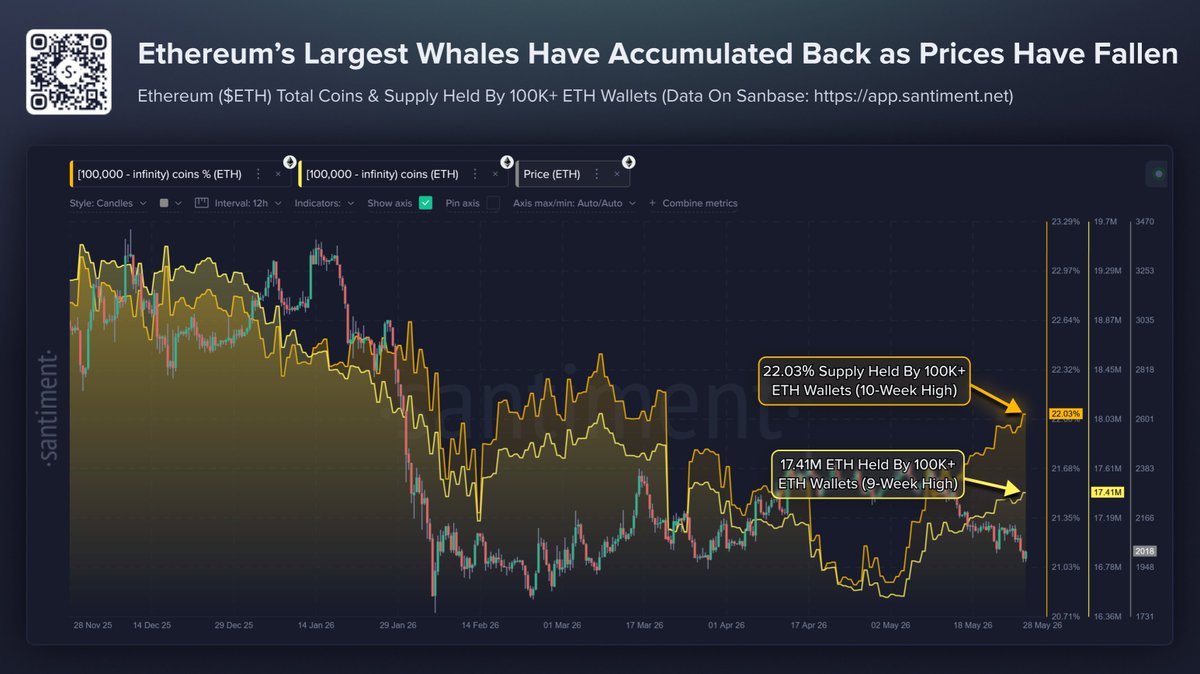
Historically, large-wallet accumulation signals growing confidence among large-scale investors. These participants typically have longer investment horizons and greater conviction than retail traders. Thus, they often accumulate during prolonged downturns and periods of uncertainty before the market eventually recovers.
However, whale buying does not always signal an immediate bottom, as the current environment reveals.
Ethereum Faces Major Breakdown Risk
Despite the whale accumulation, Ethereum’s technical structure remains fragile. Ali Martinez highlighted a key support level around $1,850. According to his analysis, a weekly close below that level would increase the probability of a larger breakdown.
The first major downside target sits near $1,560, an area that has previously acted as important support. If sellers maintain control and that level fails, the chart points to a deeper move toward roughly $1,070, which represents the lower boundary of Ethereum’s multi-year trading range.
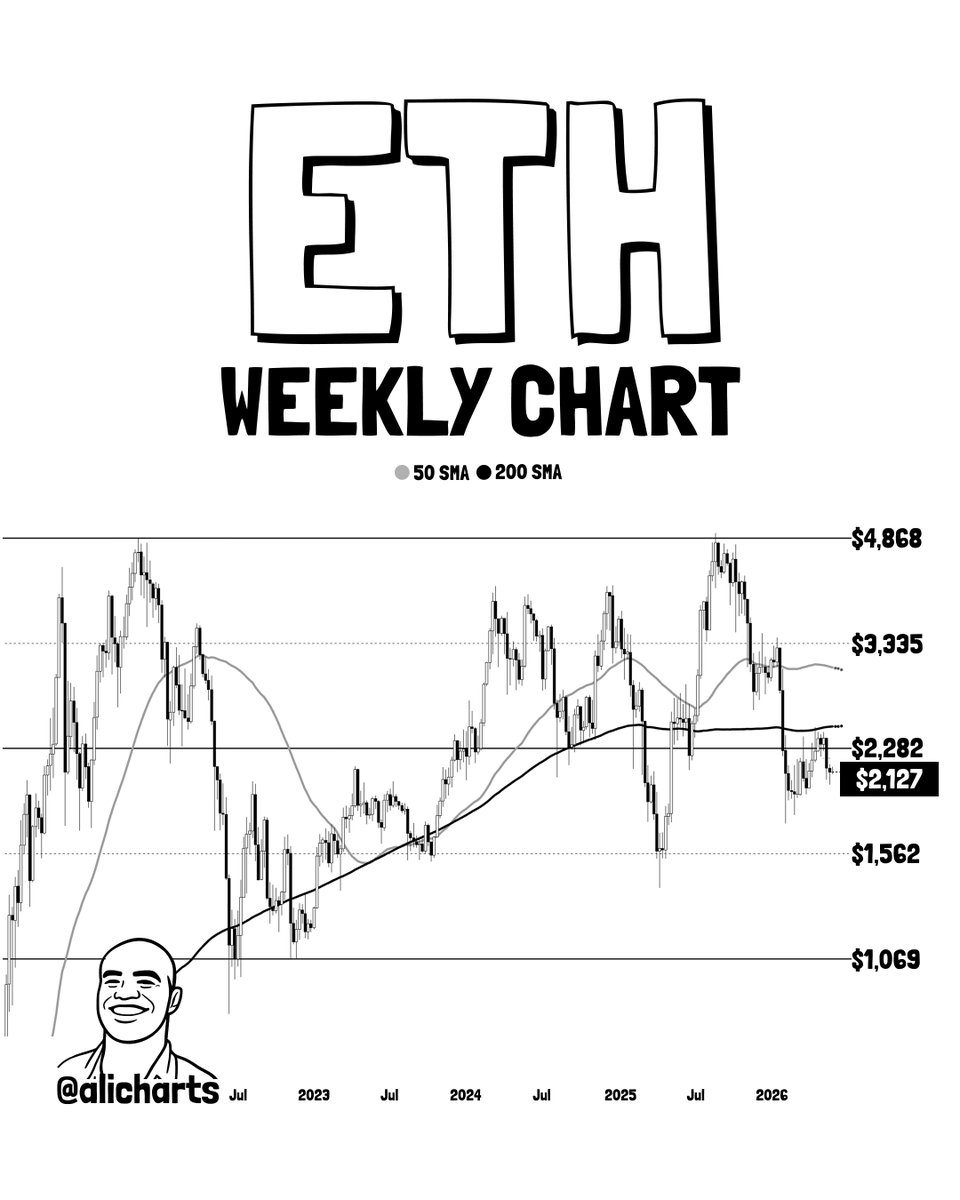
The warning comes after Ethereum briefly fell below the psychologically important $2,000 level during yesterday’s market selloff. ETH dropped to approximately $1,975 before recovering slightly. The token currently trades at $2,012. While the rebound offered some short-term relief, Ethereum continues to trade well below major resistance zones and remains far beneath its 2025 high at $4,953.
The chart also shows ETH struggling around its longer-term moving averages. Repeated failures near the $2,282 resistance region have further weakened the broader market structure and increased concerns about another leg lower.
ETF Outflows and Weak Market Conditions Add Pressure
Ethereum’s challenges extend beyond technical analysis. Spot Ethereum ETFs have experienced sustained net outflows over the past three weeks. The investment products have bled $694.8 million in that time as institutional investors reduce exposure amid escalating geopolitical tensions and tensions within the ranks of the Ethereum Foundation.
The latest wave of weakness coincided with renewed conflict involving the United States and Iran. The renewed aggression pushed investors toward a risk-off stance across global markets and into safer positions. Thus, cryptocurrencies and crypto-backed assets declined rapidly.
Ethereum has also underperformed several major sectors this cycle. AI-focused tokens, perpetual futures infrastructure projects, and revenue-generating protocols such as Hyperliquid have attracted significantly more investor attention in recent months. As a result, ETH remains one of the weaker-performing large-cap cryptocurrencies this cycle.






 The CoinRemark Team
 Evans Kelvin