



Talk of a five-year Bitcoin cycle in the crypto market made the rounds in late 2024. Bitcoin trended differently than it usually does in its original cyclical framework, fueling this narrative. However, as things have not materialized, a recent analysis has sought to explain what was really in the works for Bitcoin during this unusual cycle.
A Bitcoin Cycle that “Feels Different”
IntoTheCryptoverse founder Benjamin Cowen was one of the few major market analysts who publicly stood his ground on the claim that Bitcoin will have a four-year cycle, not five. While this narrative gained ground, even with several industry leaders pushing it, he maintained a contrary view, insisting that BTC would top last year and that a consequent bear market would ensue.
Today, he took to X to explain why this cycle was indeed different. According to him, the broader macro backdrop, particularly the late-stage business cycle environment, appears to be shaping price behavior in ways not seen in previous cycles.
He shared a chart that tracks business cycles using an M2-based liquidity indicator alongside US recession periods. Historically, major peaks in liquidity have preceded Bitcoin’s cyclical top. What stands out now is that the concluding market phase top aligned with a late business cycle environment.
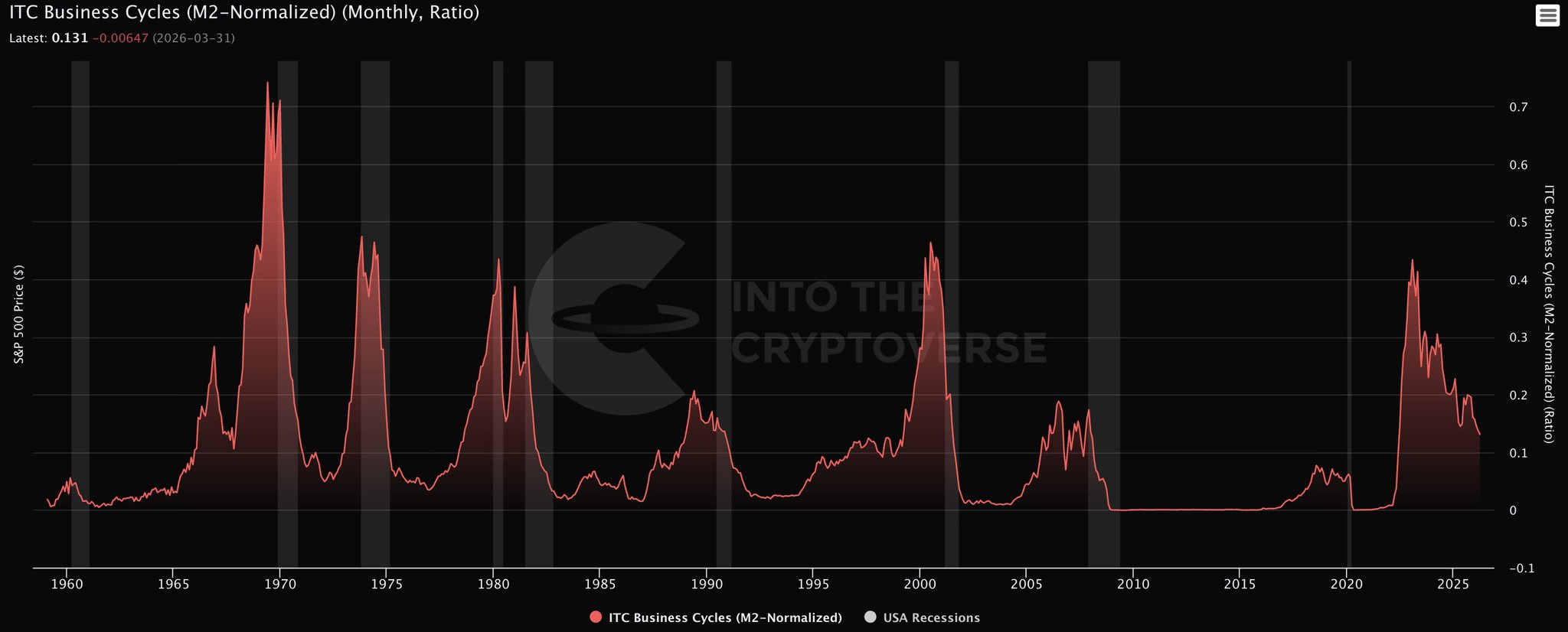
Bitcoin Peaked During a Late Business Cycle
In previous cycles, Bitcoin often reached its peak during periods of expanding liquidity and improving economic conditions. This time, the asset is navigating a late-cycle environment in which capital has barely rotated toward lower-risk assets.
https://coinremark.com/why-bitcoin-and-the-broader-crypto-market-are-down-today-march-19/
This shift helps explain several trends observed across markets. Bitcoin has struggled to outperform traditional equities such as the S&P 500, while equities have lagged behind commodities like gold. The flow of capital reflects a cautious stance as macro factors swung sideways, with investors choosing preservation over risk exposure.
Cowen explained that this was the reason there was no altcoin season. Notably, each market cycle has had a period where other cryptocurrencies outperform their leader, BTC. This time, it was not business as usual, as only a few major altcoins made new all-time highs.
When a reaction argued that the November-to-December 2024 altcoin expansion doesn’t count as an alt-season, the founder pointed to the total BTC market cap. Per an accompanying chart, the asset’s valuation barely corrected extensively to reflect a capital reallocation during that period, negating the usual capital shift to the alternative currency market.
When Bitcoin Was Close to this Macro Environment
The analyst highlighted that a similar setup briefly appeared in 2019, but that period was interrupted by a global shock that effectively reset the cycle. During that period, Bitcoin was on a recovery stage after the 2019 bear market, which aligned with the business cycle.
However, the COVID-19 pandemic struck, resetting the business cycle. On the other hand, BTC showed strength, rebounding to a new all-time high in 2021. During the current market cycle, there has not been an event to sunset the business cycle and start a reset.
Waiting for a Macro Reset
Without a clear end to the business cycle, Cowen noted that higher-risk assets continue to face steady pressure. Liquidity is no longer expanding at the same pace, and that change tends to weigh on assets that rely on strong inflows to sustain upward momentum.
For Bitcoin, this environment creates a slower and more uneven path compared to prior cycles. The typical explosive phase associated with cycle tops has been replaced by a more gradual price bleed.
Until the broader cycle concludes, this pattern may persist. A decisive shift in macro conditions, whether through policy changes or an external shock, would reset the landscape and allow Bitcoin to regain strength.
Different Business Cycle Narratives
Notably, market veteran Dan Gambardello shares a different timeline for the business cycle using the manufacturing purchasing manager’s index (PMI). Recently, he highlighted that the metric is slowly turning positive after years of compression.
Gambardello claimed that this market indicator has closely aligned with the crypto market and that the sector struggled in the concluding cycle due to its underperformance. With this indicator now showing signs of life, the analyst expects it to spearhead the next bullish phase.





 Evans Kelvin