




In today’s crypto news, Bitcoin is testing one of the most important support levels in its history. After the cryptocurrency’s recent sell-off, it is now testing a long-term trendline that has supported every major Bitcoin cycle low since 2017. Historically, each touch of this support has preceded substantial rallies, leading some analysts to believe Bitcoin may be approaching another major turning point.
The setup comes after Bitcoin suffered one of its sharpest corrections of the current cycle. The asset recently fell below $60,000 and briefly touched the $59,000 region before stabilizing around $61,200.
Bitcoin Revisits a Critical Long-Term Support
The trendline in question has acted as the foundation of Bitcoin’s long-term bull market for nearly a decade. It successfully held during major corrections in 2017, 2018-2019, 2020, and 2022.
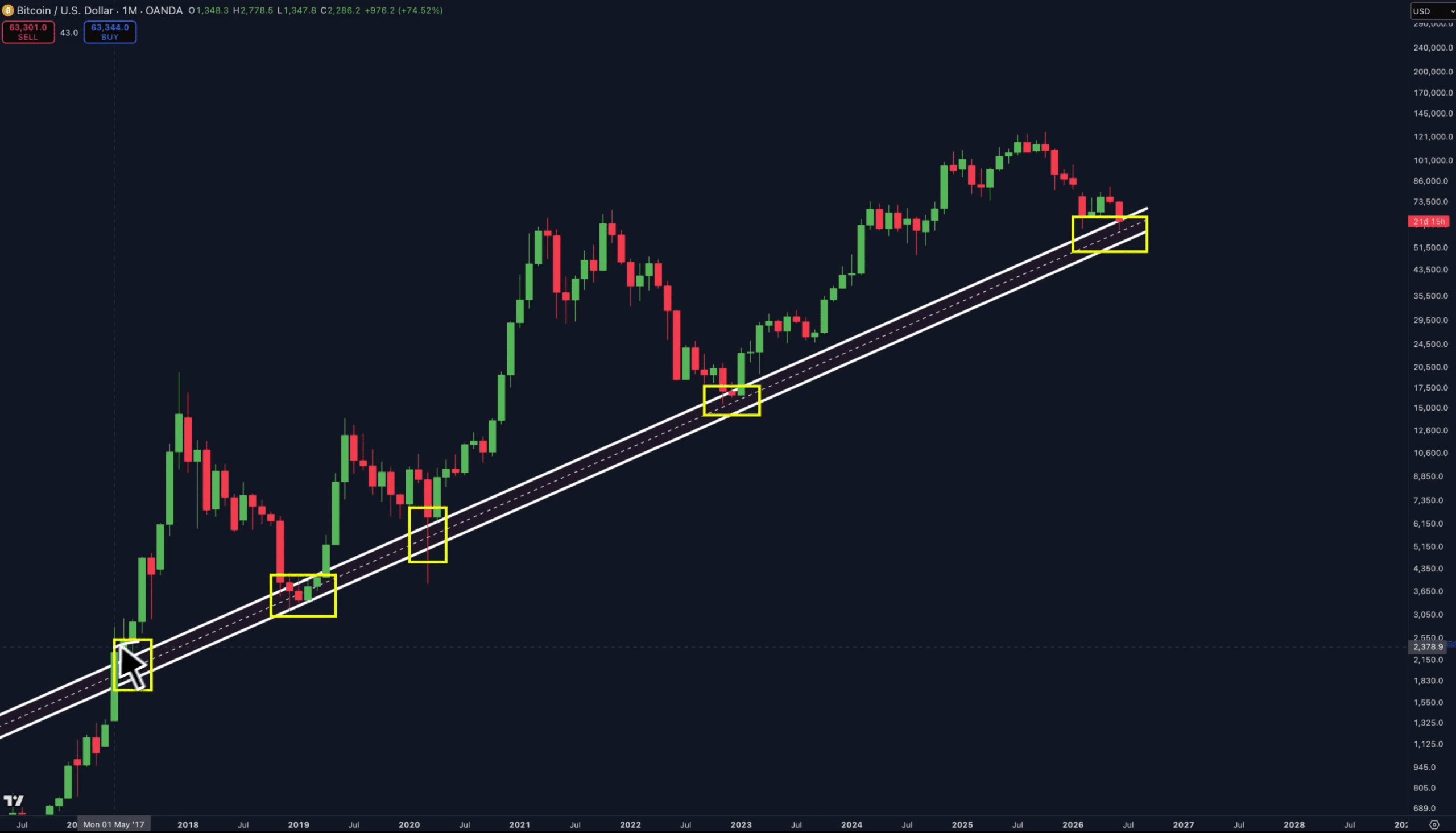
The historical performance following previous tests of this support level has been remarkable. After touching the trendline in 2017, Bitcoin went on to rally approximately 980%. The next major test arrived during the 2018-2019 bear market and preceded a surge of roughly 400%.
A similar pattern emerged during the 2020 correction, where Bitcoin again advanced nearly 1,700% after finding support. Even the 2022 bear market low eventually led to a recovery of about 730%. Bitcoin is now approaching the same support zone once again. While no technical level works forever, a few support zones in Bitcoin’s history have produced such a consistent track record of major rebounds.
On average, Bitcoin has rallied 1,450% from this 9-year ascending support trendline.
Multiple Indicators Suggest Bitcoin Is Undervalued
The trendline is not the only signal suggesting Bitcoin may be nearing a bottom. Recent analysis from CryptoQuant showed Bitcoin’s Market Value to Realized Value (MVRV) ratio falling to 1.1. Historically, an MVRV reading near 1.0 has marked major market bottoms, including those seen in 2015, 2019, and 2022. The metric measures whether Bitcoin is trading above or below its historical cost basis and is widely used to identify periods of undervaluation.
Meanwhile, institutional activity remains mixed. Spot Bitcoin ETFs have lost nearly $5 billion over the past three weeks as investors reduced exposure amid market uncertainty. More than $1.6 billion in crypto positions were also liquidated during Bitcoin’s recent plunge.
Despite that weakness, some major buyers continue accumulating. Strategy recently purchased another 1,550 BTC worth approximately $101 million, increasing its total holdings to 845,256 BTC. BlackRock’s IBIT also started attracting selective inflows even as the broader ETF sector experienced outflows.
If the nine-year support line holds, Bitcoin could be positioned for new all-time highs. However, a decisive breakdown would mark the first failure of this trendline in nearly a decade and could open the door to a deeper move into the low $50,000 range.







 The CoinRemark Team
 Evans Kelvin