
In today’s crypto update, Uniswap (UNI) has emerged as one of the strongest performers this week. The decentralized exchange’s token surged more than 24% over the past 24 hours, pushing above $3.5 as whale activity and trading volume soared. The rally has renewed investor interest in the token and drawn attention to Standard Chartered’s bold long-term outlook.
Whale Activity Accelerates as UNI Records Major On-Chain Spike
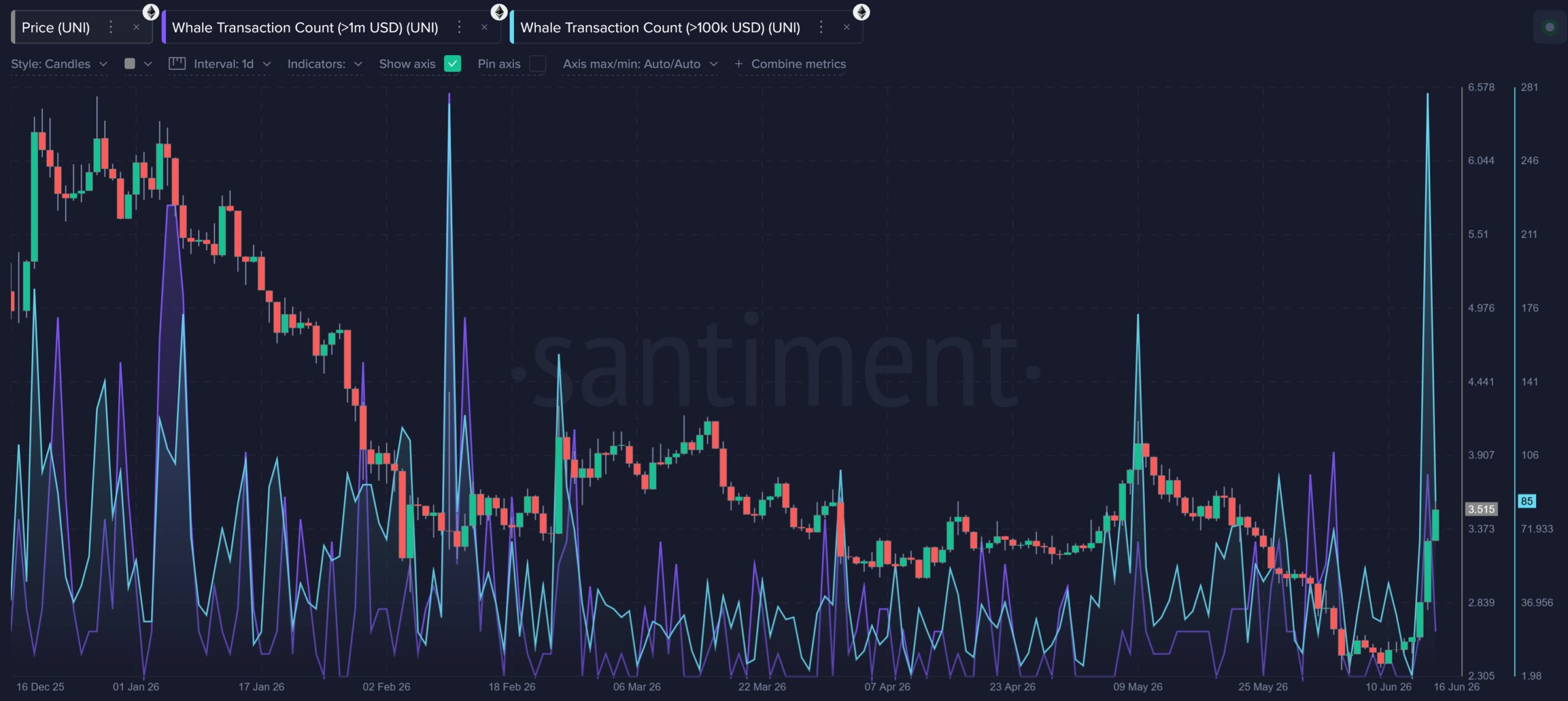
Large investors have played a major role in UNI’s recent rally. Data from Santiment shows a sharp increase in whale activity on June 16. Transactions worth more than $100,000 surged to 281, while transactions exceeding $1 million climbed to 85, marking one of the highest whale activity spikes in recent months.
The surge in whale transactions coincided with a significant increase in trading activity across the network. Santiment data shows UNI’s trading volume climbed to $590.66 million, while its market cap reached $2.17 billion. The spike in demand helped fuel a powerful price rally. Over the past 24 hours, UNI jumped by 24%, surging past the $3.5 mark and emerging as one of the best-performing major cryptocurrencies.
The sharp move helped the token break out from recent lows and attracted fresh attention from both retail and institutional investors. The combination of rising whale activity, growing trading volume, and strong price performance suggests that major holders are positioning for further upside. As bullish sentiment returns to the DeFi sector, Uniswap appears to be regaining momentum after weeks of market weakness.
Standard Chartered Sees UNI Reaching $100 by 2030
Meanwhile, shortly before UNI’s explosive rally, banking giant Standard Chartered issued a bullish long-term forecast for the token. The bank projected that UNI could reach $100 by 2030, representing a gain of 2,753% from current levels. The forecast is tied to the rapid growth of tokenized real-world assets. Standard Chartered believes a growing share of traditional financial assets will move on-chain over the coming years, creating significant opportunities for decentralized finance protocols.
According to the bank, Uniswap is well-positioned to be at the center of this transformation. The prediction comes shortly after tokenized stocks launched on the Uniswap ecosystem. Since launch, these assets have generated more than 2.6 million transactions, highlighting the growing demand for tokenized financial products. Standard Chartered expects the value of tokenized assets to rise sharply in the coming years. The bank estimates that the market currently stands at around $340 billion.
However, it projects the figure could expand to $4 trillion by 2028 as more institutions embrace blockchain-based financial infrastructure. The bank also expects a larger share of these tokenized assets to participate in DeFi protocols. According to its projections, the percentage of tokenized assets interacting with DeFi could increase from 3.5% today to 30% by 2030.
As a result, Standard Chartered forecasts a massive expansion in decentralized finance activity. The bank projects that DeFi’s total value locked (TVL) could surge 37-fold to $2.7 trillion by the end of the decade. If achieved, that figure would exceed the current capitalization of the global cryptocurrency market.
Standard Chartered Maps Out UNI’s Path to $100
Meanwhile, Geoff Kendrick, Head of Digital Assets Research at Standard Chartered, has outlined a four-year roadmap for UNI to reach the bank’s ambitious $100 price target by 2030. According to Kendrick, Standard Chartered expects UNI to reach $6.50 by the end of 2026, marking the first major milestone in its long-term forecast. The bank then projects the token to rise to $20 by the end of 2027 as tokenized assets continue to flow into the DeFi ecosystem.
The bullish outlook does not stop there. Standard Chartered expects UNI to reach $40 by the end of 2028 and $65 by the end of 2029, before ultimately hitting $100 in 2030. For now, however, investors remain focused on the first checkpoint. All eyes are on whether UNI can actually reach the $6.50 target by year-end. Failure to achieve that milestone could raise questions about the feasibility of the remaining projections and make the rest of the roadmap appear far more challenging.



 The CoinRemark Team
 Evans Kelvin