



Public Bitcoin miners liquidated more BTC in Q1 2026 than any other quarter in recent years. Data from TheEnergyMag revealed a surge in miner sell-offs amid worsening mining conditions. The sharp increase highlights how tightening margins and rising operational costs contribute to growing pressure within the mining sector.
The development also comes as Bitcoin recovers from recent weakness. The premier cryptocurrency has held above $70,000 for the past week, even climbing as high as $78,200 on Friday. While the BTC price is down to $75,270 at the time of writing, the token is still holding 6% higher than last week’s price.
Bitcoin Miners Liquidate Record 32,000 BTC
The latest data captures a significant spike in miner selling activity during the first quarter of 2026. Public Bitcoin miners sold over 32,000 BTC. Compared to previous quarters, the volume stands out as a clear outlier, with no comparable level of liquidation in recent years. In fact, the figure exceeds the total amount of miner Bitcoin liquidations in 2025.
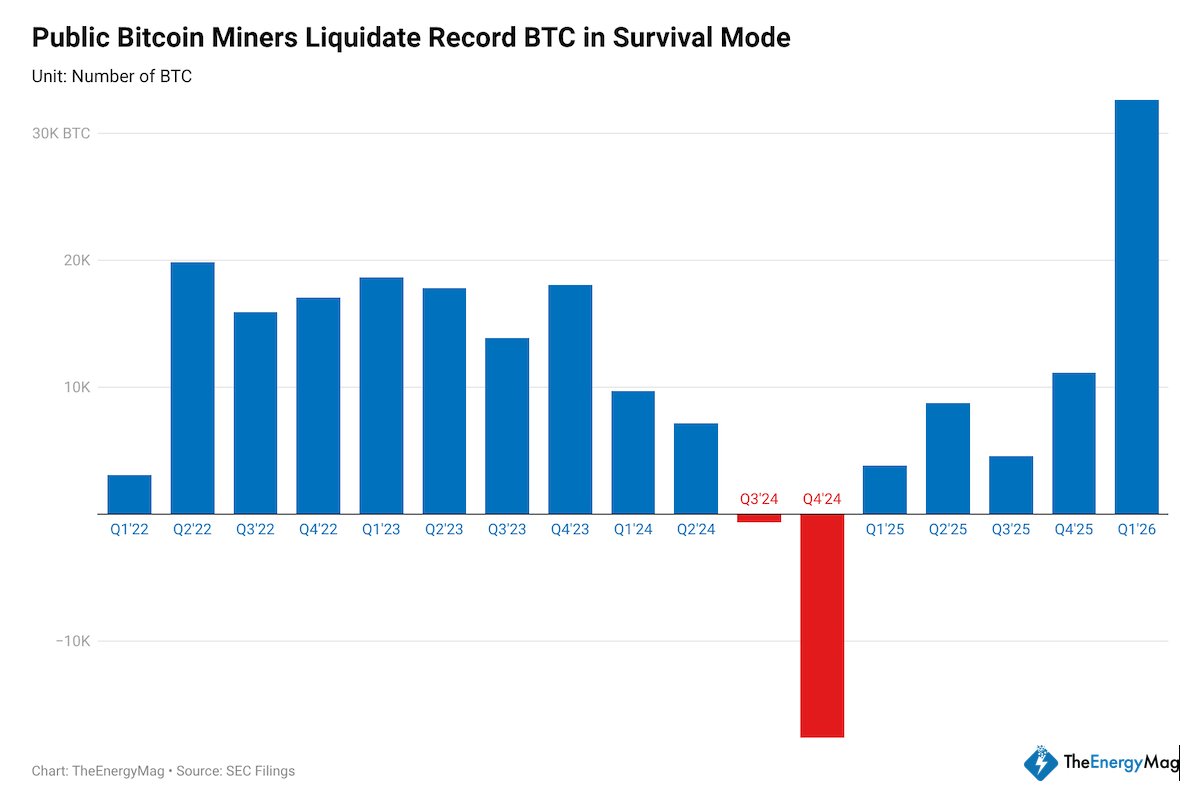
Major publicly listed mining firms, including MARA, CleanSpark, Riot Platforms, and Bitdeer, contributed to the surge. For instance, MARA recently revealed that it had sold about 15,133 BTC to buy back $1 billion in convertible senior notes. The scale of the sell-off suggests that the behavior is not isolated but reflects a broader industry trend.
Mining Sector Enters Survival Mode
The surge in liquidations comes as mining profitability continues to decline. Rising network difficulty and competition have increased the cost of securing Bitcoin, while energy expenses remain elevated. As a result, mining operations now require a large capital investment. The scale and timing of the sell-off indicate that many miners are operating under financial strain.
Revenue per unit of computing power has compressed considerably recently, pushing many miners closer to breakeven levels. Under these conditions, holding mined Bitcoin becomes less viable. Rather than accumulating Bitcoin, firms are prioritizing liquidity to cover operational costs and maintain balance sheets.
While miners are increasing their selling activity, other segments of the market continue to accumulate Bitcoin. Institutional investors and ETF flows have remained active, creating a divergence between forced selling and strategic buying. This dynamic introduces a new layer to market structure, where supply from miners is being absorbed by longer-term holders.






 The CoinRemark Team
 Evans Kelvin