


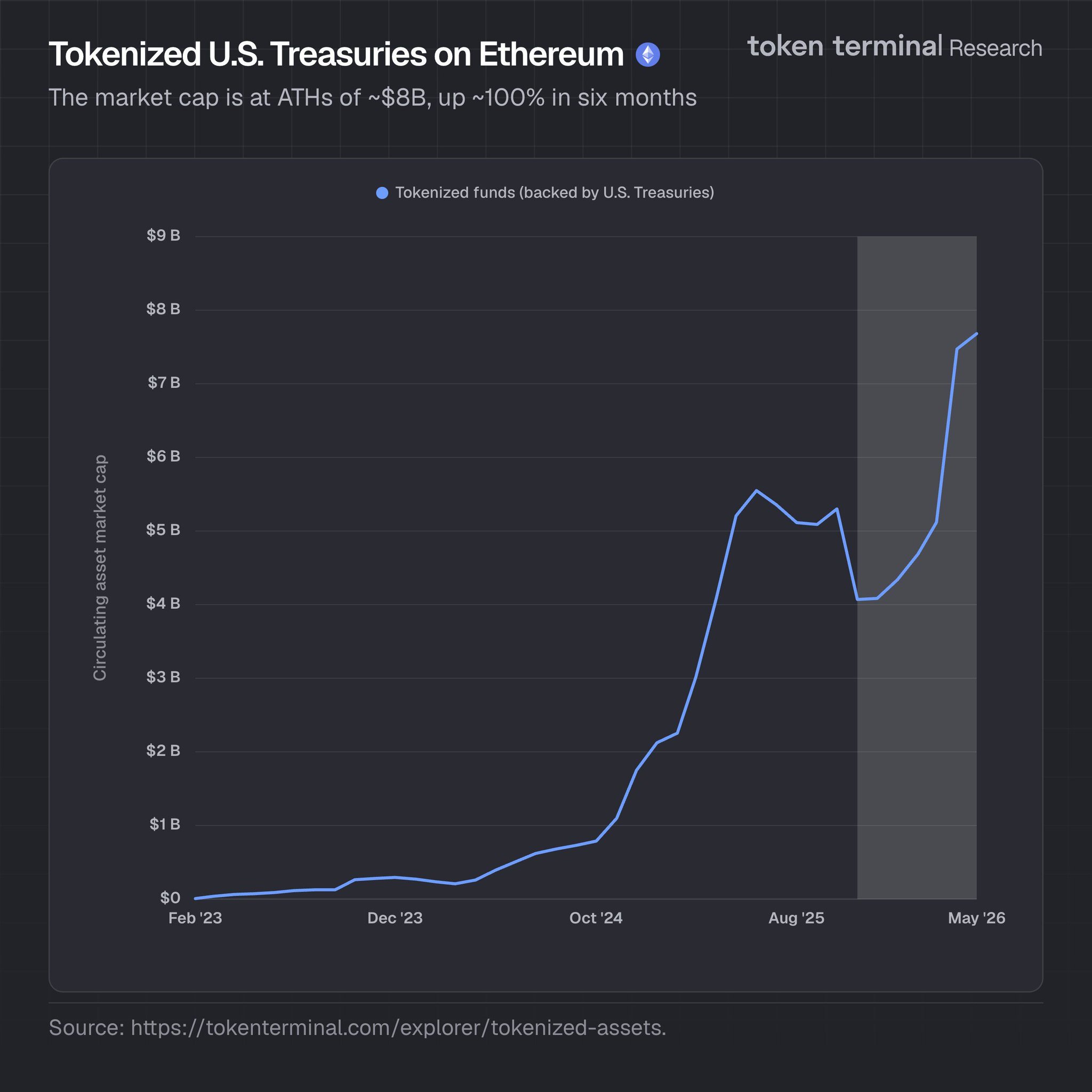
In today’s crypto news, tokenized U.S. Treasuries on Ethereum have reached a new all-time high. According to data from Token Terminal, the sector has reached approximately $8 billion in value. The milestone marks a dramatic acceleration in one of crypto’s fastest-growing sectors, with the market doubling in size over the past six months alone.
The surge also reinforces Ethereum’s position at the center of the tokenization movement. A recent CoinRemark coverage highlighted the network’s evolving role in financial markets as the prime destination for tokenization.
Institutional Products Are Driving the Expansion
The current tokenized Treasury value surge to $8 billion represents a 100% increase over the past 6 months. The increase has been fueled by a growing list of institutional products launched over the past two years. Major players now include BlackRock’s BUIDL fund, Franklin Templeton’s Benji platform, and Securitize-backed offerings. These products allow investors to gain exposure to Treasury yields while benefiting from blockchain-based settlement and accessibility.
BlackRock’s BUIDL fund, in particular, has become one of the strongest symbols of institutional adoption in the sector. The fund brought one of the world’s largest asset managers directly into blockchain-based finance. With that move, BlackRock signaled its confidence in tokenized infrastructure and bet on the future of global finance.
Franklin Templeton has also expanded aggressively through its Benji platform, which has emerged as one of the fastest-growing tokenized Treasury products in the market. Meanwhile, firms such as Ondo Finance have focused on integrating tokenized yield-bearing assets into decentralized finance ecosystems.
Thus, tokenized Treasuries have become one of the largest and fastest-growing categories within the broader RWA market. This is no coincidence. Compared with other assets, Treasuries offer institutions a relatively low-risk, well-known entry point into blockchain systems. Especially in high-interest environments, Treasuries offer attractive yields. Thus, these conservative financial instruments are the perfect testing ground for institutions to gain on-chain exposure.
Ethereum Remains the Core Infrastructure Layer
Ethereum continues to dominate the tokenized Treasury market, hosting the majority of on-chain Treasury products and broader real-world assets (RWAs). Estimates place Ethereum’s share of tokenized U.S. Treasuries above 50%. Clearly, it is the primary settlement and issuance layer for institutions entering the space.
The network’s advantage stems from several factors. Ethereum has a large decentralized finance ecosystem, with roughly $50 billion in total value locked across DeFi applications. It also maintains the largest concentration of stablecoin liquidity and institutional-grade infrastructure.
Security and regulatory familiarity have also played important roles. Many institutions view Ethereum as the most battle-tested smart contract platform, with years of operational history and extensive developer support. These characteristics make it attractive for financial products that require stability, liquidity, and broad interoperability. Hence, Ethereum is evolving into a core financial infrastructure.
The Broader Tokenization Narrative Accelerates
The latest milestone comes amid a wave of institutional activity surrounding tokenization. Recent CoinRemark coverage highlighted Grayscale’s research report, which describes tokenization as a potential $300 trillion market opportunity. According to the report, only about 0.01% of global financial assets are currently on-chain. Thus, the sector is in its earliest stages, with significant potential for growth.
At the same time, infrastructure providers are moving aggressively to position themselves for that future. Bullish recently announced its $4.2 billion acquisition of Equiniti to expand into tokenized securities infrastructure, while Securitize has entered partnerships with major financial players to support the issuance and management of tokenized assets.
Ethereum appears to be one of the biggest beneficiaries of this growing trend. As more financial activity migrates on-chain, demand for Ethereum’s infrastructure, liquidity, and settlement capabilities could continue to grow alongside the tokenized asset market itself.





 The CoinRemark Team
 Evans Kelvin