



Bitcoin exchange activity is flashing a notable signal as inflows to Binance drop to levels last seen in 2020. The slowdown suggests a shift in investor behavior, with market participants opting to hold rather than sell amid ongoing uncertainty in the crypto landscape.
Investors Favor Holding Bitcoin Over Selling
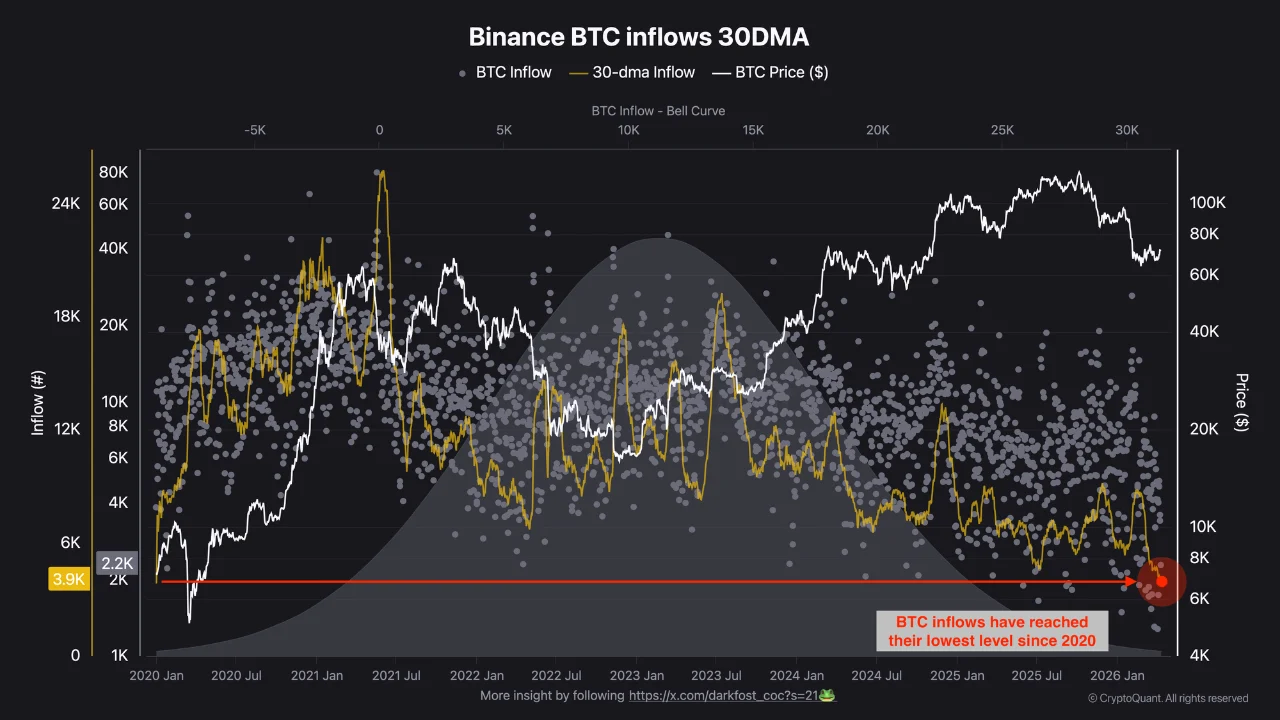
Recent insights from CryptoQuant analyst Darkfost highlight a sharp decline in Bitcoin inflows to Binance. According to Darkfost, the 30-day moving average of BTC inflows now sits around 3,998 BTC, a level not seen since 2020.
The analyst further noted that Binance’s BTC historical average inflow is around 11,000 BTC, meaning current levels are roughly three times lower than normal. This marks a stark contrast to previous periods of heightened activity, including over 19,000 BTC per day during July 2023 and more than 25,000 BTC per day in May 2021.
Against this backdrop, Darkfost emphasized that the contraction in inflows signals a shift in investor behavior. Rather than positioning to sell, market participants appear to be favoring a holding strategy, a trend that mechanically reduces short-term selling pressure.
Market Enters Wait-and-See Mode
Meanwhile, Darkfost also highlighted that the decline in inflows reflects a broader sense of caution across the market, driven by persistent global economic uncertainty. Investors are closely monitoring geopolitical developments, particularly the ongoing tensions between the United States and Iran, which continue to weigh on risk sentiment.
In addition, regulatory uncertainty has added to the mixed outlook, with delays surrounding the proposed CLARITY Act further clouding market direction. As a result, the analyst notes that investors are increasingly adopting a wait-and-see approach rather than taking aggressive positions. Rather than signaling capitulation, current conditions suggest the market is in a holding pattern, with many participants remaining passive instead of reacting with panic.
ETFs Present A Structural Shift
Darkfost further explained that the dip in BTC inflows to Binance may also reflect a broader structural shift in the market. According to the analyst, a growing portion of Bitcoin flows are now being redirected through alternative investment vehicles such as spot ETFs, reducing the need for investors to move assets onto exchanges.
Recent data cited by CoinRemark shows that crypto investment products recorded $1.1 billion in inflows over the past week, with Bitcoin alone accounting for $871 million. This trend underscores rising institutional participation and a shift toward regulated exposure channels.
Notably, these inflows coincided with a brief market uptrend. According to CoinMarketCap, Bitcoin has gained 5.3% over the past 24 hours, climbing above the $74,000 level. While reduced exchange inflows continue to ease immediate selling pressure, the combination of institutional demand and constrained supply could help support price stability. However, analysts maintain that sustained bullish momentum will depend on broader market conditions and continued capital inflows.






 The CoinRemark Team
 Evans Kelvin