




Cardano is drawing renewed attention in the crypto space after claims that it is roughly 73,000 times more energy efficient than Bitcoin. The stark contrast underscores a broader industry shift toward sustainable blockchain technologies as environmental concerns continue to shape investor and institutional sentiment.
Community Figure Highlights Cardano Ouroboros as Key Driver of Efficiency
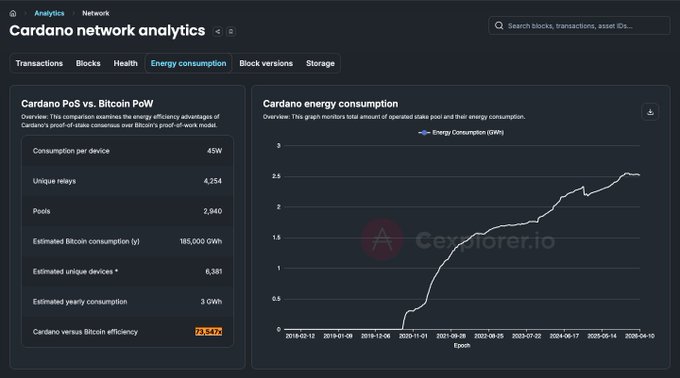
A prominent community figure on X, identified as Mintern, has claimed that Cardano is more energy-efficient than Bitcoin. Referencing a chart from Cexplorer, Mintern shows that Bitcoin consumes 185,000 GWh per year, while Cardano consumes roughly 3 GWh, making it 73,547 times more energy-efficient.
Meanwhile, according to the post, this significant advantage is largely attributed to Cardano’s Ouroboros proof-of-stake protocol. Ouroboros, widely recognized as the first peer-reviewed PoS algorithm, was designed with sustainability, security, and energy efficiency at its core. Unlike traditional proof-of-work systems that rely on high computational power for block validation, Ouroboros selects validators based on their stake in the network.
This removes the need for energy-intensive mining hardware and drastically cuts electricity consumption. Further, by distributing validation responsibilities among stakeholders rather than concentrating them in high-powered mining operations, Cardano achieves a more streamlined and scalable infrastructure. This architectural approach not only enhances efficiency but also aligns with the growing demand for environmentally responsible blockchain solutions.
Charles Hoskinson Says Cardano Is More Decentralized Than Bitcoin
Bitcoin’s Energy-Heavy Model Under Scrutiny
In contrast, Bitcoin continues to rely on its proof-of-work consensus model, which requires miners to compete in solving complex mathematical puzzles. This process consumes vast amounts of electricity, making it one of the most energy-intensive blockchain networks in operation.
Interestingly, Bitcoin mining operations account for roughly 0.5% of global electricity consumption. This level of consumption is comparable to the annual energy demand of countries such as Argentina and Poland.
Even more striking, the energy required for a single Bitcoin transaction is estimated to be enough to power an average U.S. household for up to 49 days. These figures continue to fuel criticism from environmental advocates and policymakers, particularly as sustainability becomes a central focus in global financial and technological systems.
Sustainability Becomes a Competitive Advantage
As the crypto market evolves, sustainability is emerging as a defining factor for long-term adoption. Cardano’s energy-efficient framework positions it well to attract institutional investors, particularly those adhering to environmental, social, and governance (ESG) standards.
As pressure on blockchain networks to reduce their carbon footprint intensifies, projects that prioritize efficiency may gain a decisive edge. Cardano’s Ouroboros-driven model highlights how innovation in consensus mechanisms could shape the next phase of growth in the digital asset ecosystem.
Bullish CEO Mentions Cardano and Midnight as Potential Winners in Multi-Chain Crypto Future







 The CoinRemark Team
 Evans Kelvin