


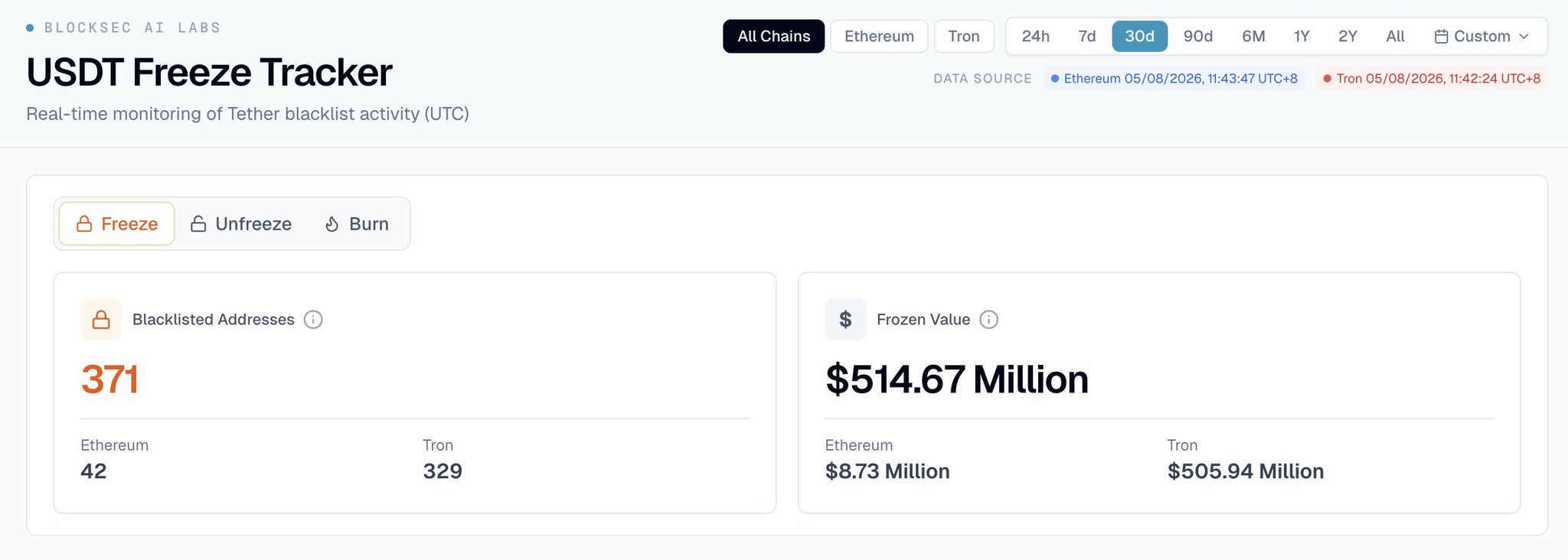
In today’s crypto news, Tether has frozen approximately $514.67 million worth of USDT across Ethereum and Tron over the past 30 days. According to data from BlockSec’s USDT Freeze Tracker, the stablecoin issuer blacklisted 371 wallet addresses between the two networks as of May 7, 2026. The figures highlight the growing scale of enforcement activity surrounding the world’s largest stablecoin. Additionally, they underscore Tether’s increasingly central role in crypto compliance infrastructure.
Tron Dominates USDT’s Freeze Activity
Most of the frozen value was concentrated on the Tron blockchain. Data from the tracker shows that Tron accounted for 329 of the 371 blacklisted addresses. These wallets accounted for approximately $505.94 million of the total frozen funds. Ethereum, by comparison, accounted for 42 blacklisted addresses involving roughly $8.73 million in frozen USDT.
The imbalance reflects Tron’s dominant role in stablecoin transfers. Thanks to its low fees and fast settlement speeds, Tron has become one of the largest networks for USDT activity globally. The network is especially utilized in cross-border transfers, OTC settlements, and emerging-market transactions. That higher transaction volume naturally creates greater exposure to illicit finance monitoring and enforcement actions.
Tether’s Expanding Compliance Role
Tether’s blacklist mechanism allows the company to freeze USDT held in specific wallet addresses. Once blacklisted, those funds can no longer be transferred or redeemed. While USDT operates on public blockchains like Ethereum and Tron, the token itself remains centrally issued and controlled by Tether, giving the company the ability to intervene directly when required.
Over the past several years, Tether has increasingly taken action to support financial enforcement efforts. The company has previously frozen funds linked to hacks, scams, sanctions violations, and money laundering investigations. Additionally, they have lent their support to blockchain analytics firms and law enforcement agencies to effect such restrictions.
In a recent report, the stablecoin issuer outlined its key role in restricting access to funds from illicit activities. The firm provided this key support to U.S. authorities, resulting in freezing $344 million USDT across two addresses. It described such actions as a routine part of its response to authorities’ requests for such support. The latest figures suggest that this enforcement activity continues to expand alongside the broader growth of stablecoin usage.
The development also revives a long-standing debate around stablecoin centralization. Supporters argue that blacklist capabilities are necessary to combat fraud and improve institutional confidence in digital assets. Critics, however, point out that the ability to freeze assets introduces censorship risks and creates dependence on centralized issuers.
Stablecoins Move Further Into Regulated Finance
Blockchain networks themselves remain decentralized infrastructure layers, but stablecoins built on top of them can still operate under centralized control. In practice, this means users benefit from the speed and accessibility of blockchain settlement while remaining subject to issuer oversight and intervention.
This structure may become increasingly important as crypto hacks and cybertheft ramp up at an unprecedented rate in 2026. A recent CoinRemark coverage had outlined how Arbitrum retrieved $70.97 million in Ethereum from hackers linked to the KelpDAO exploit. Thus, maintaining a level of control over issued stablecoins may help regulate the rate of crypto crimes.






 The CoinRemark Team
 Evans Kelvin