



Global crypto adoption has continued to accelerate as retail payment activity gains momentum across the industry. Platforms like Binance Pay are also seeing growing usage tied to everyday purchases such as food, groceries, and transport. Meanwhile, the rapid expansion of the real-world asset tokenization sector and ongoing discussions on improving crypto regulation are further strengthening long-term adoption prospects.
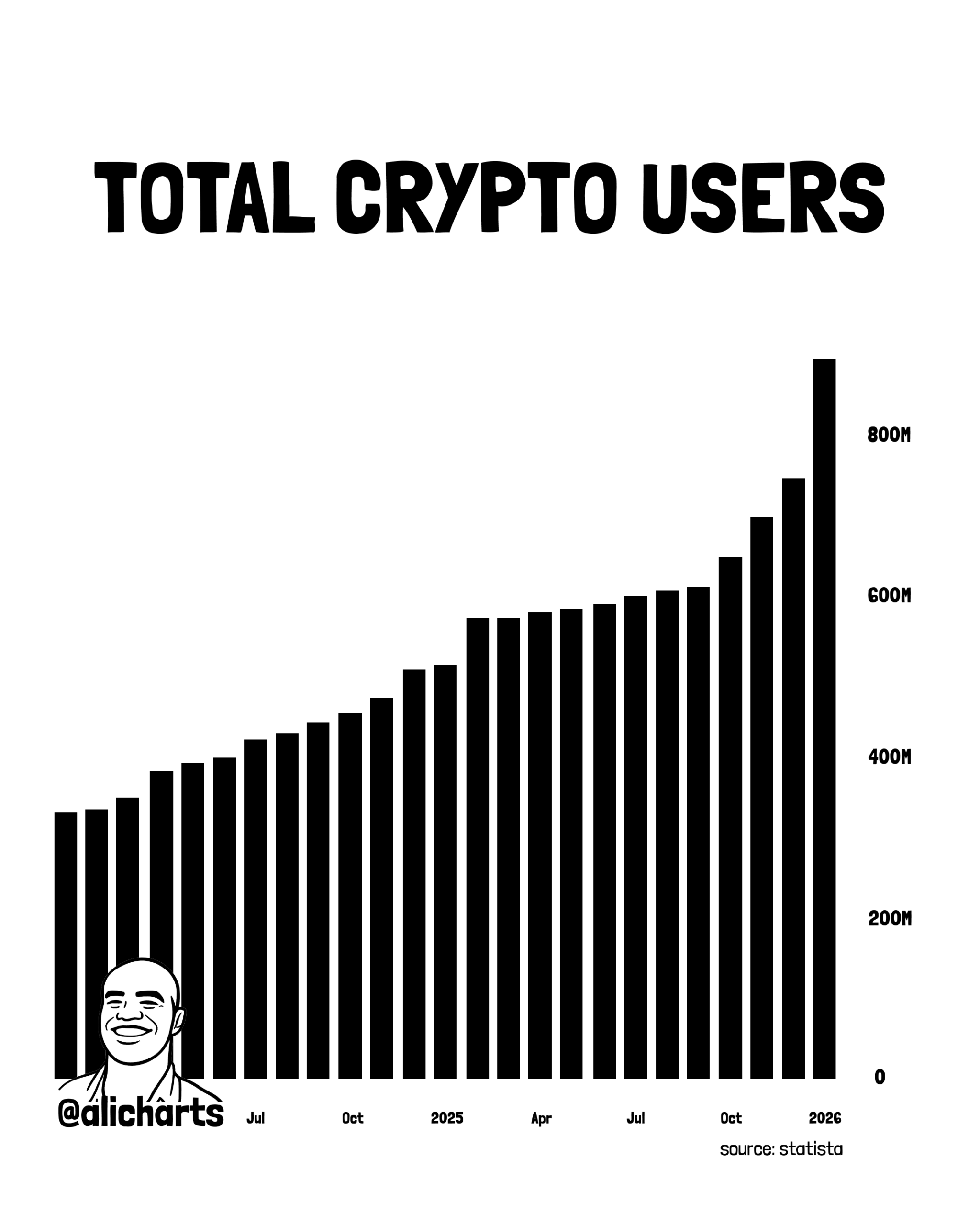
Global Crypto User Base Crosses 800 Million
In a recent crypto update, market expert Ali Martinez claimed that the crypto industry has reached another major milestone as worldwide adoption continues to expand. Citing recent data from Statista, Martinez noted that global crypto users have now crossed 800 million.
Among the largest contributors to that growth is Binance, which now reports more than 315 million registered users globally. The exchange remains one of the dominant players in the digital asset sector as adoption spreads across both developed and emerging markets.
The latest numbers suggest crypto is gradually becoming more mainstream. While trading activity still accounts for a major share of usage, industry participants are beginning to see stronger engagement with real-world utility.
Meanwhile, this growth stems from faster blockchain networks, improved wallet infrastructure, and lower transaction costs. Stablecoins have also played a key role in encouraging payment adoption by reducing price volatility.
Retail Transactions and Binance Pay Activity Surge
Ali Martinez also highlighted the growth of retail crypto payments in 2025. According to recent data, retail transaction activity increased by 125% year over year, highlighting rising interest in using crypto for smaller, more frequent purchases. The increase points to a shift in user behavior. More consumers are beginning to treat crypto as a payment option rather than only a speculative investment.
Interestingly, Martinez also reported that Binance Pay, the Binance exchange’s contactless, borderless, secure payment solution, has now processed more than $280 billion in transaction volume. It is worth noting that a significant portion of the volume came from growing activity across simple use cases such as food, transport, and groceries. This growing activity highlights increasing demand for crypto payment infrastructure as crypto slowly moves into everyday transactions.
RWA Tokenization Sector Records Massive Growth
Beyond payments, the rapid expansion of the real-world asset tokenization sector is also contributing to broader crypto adoption. According to CoinGecko, the tokenization sector has grown by more than 69% since 2024, with its total market capitalization currently exceeding $230 billion. Fiat-backed stablecoins dominate the sector, currently accounting for approximately $224.9 billion of the total market value.
The growth highlights increasing institutional and retail demand for blockchain-based financial products tied to real-world assets. Interestingly, due to the sector’s explosive growth, many analysts and financial institutions have projected that the real-world asset tokenization market could reach a valuation of $30 trillion by 2030.
At the same time, investors are closely monitoring the upcoming Crypto Clarity Act in the United States. The proposed legislation is expected to provide clearer regulatory guidelines for digital assets, exchanges, and blockchain companies. Recently, the Senate Banking Committee and several crypto firms reportedly reached a deal on stablecoin yield policies, an issue that had mounted a major roadblock for several months, hindering the committee’s markup and voting process.
Market participants believe improved regulatory clarity could encourage further institutional investment and boost consumer confidence in the broader crypto market. Together, tokenization growth and regulatory developments are increasingly viewed as major catalysts for the next phase of crypto adoption.







 The CoinRemark Team
 Evans Kelvin