


Cardano has become one of the most discussed cryptocurrencies in today’s crypto market.
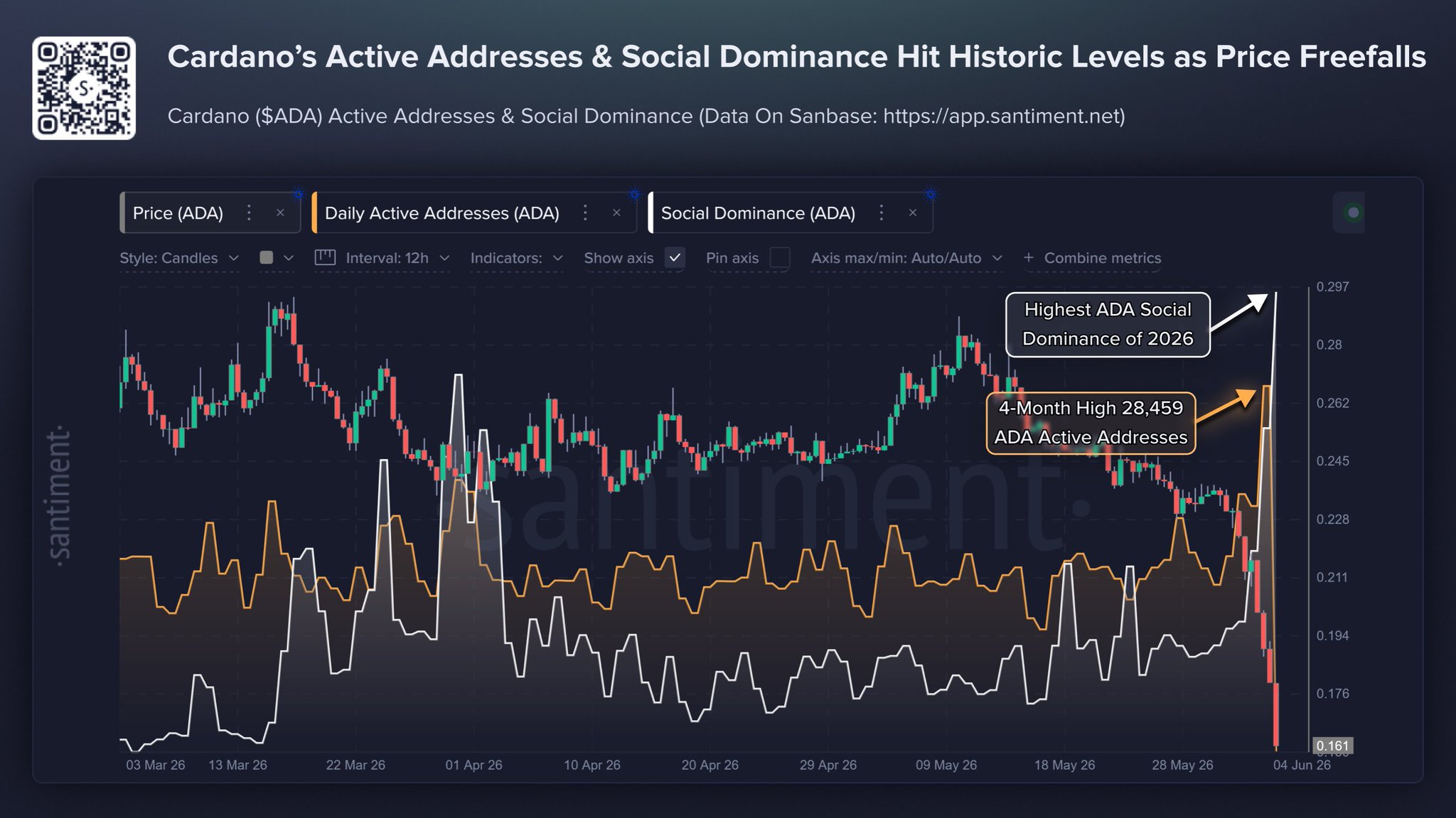
According to new data from Santiment, ADA’s social dominance surged to approximately 0.52%, its highest level of 2026. The spike in attention comes as Cardano founder Charles Hoskinson confirmed that he is taking a break following a series of setbacks across the ecosystem.
Santiment noted that more than one out of every 190 crypto-related discussions across social media platforms focused on Cardano. While rising social dominance often accompanies bullish price action, the opposite is happening in ADA’s case. Much of the conversation centers around the uncertainty surrounding the network’s future, as investors react to a growing list of ecosystem challenges.
At the same time, Cardano’s daily active addresses climbed to 28,459, the highest level in four months.
Ecosystem Challenges Fuel Investor Concerns
Investor anxiety intensified after Hoskinson warned that parts of the Cardano ecosystem could face a wave of failures as projects struggle with funding challenges and declining activity. Ultimately, he announced that he was taking a break but returned briefly to reassure the community that he was not resigning or abandoning the ecosystem. His comments have proved true, as several disappointing developments have recently swept across the network.
Over the past six weeks, both JPG.Store and TapTools announced plans to shut down operations. JPG.Store is Cardano’s largest NFT marketplace, while TapTools was one of the ecosystem’s most recognizable analytics platforms.
The network also suffered another setback when Cardano Summit 2026 was canceled after a proposal requesting 7.8 million ADA in funding received roughly 65%, just two points below the approval threshold.
These developments have fueled concerns that ecosystem growth has slowed significantly. The negative headlines also coincide with one of the worst price performances in Cardano’s history. ADA lost the psychological support at $0.20 and currently trades at $0.16, marking its lowest level since December 2020. The token is now down approximately 94% from its September 2021 all-time high near $3.10.
Broader market conditions have also added pressure. Bitcoin’s collapse toward $61,000 triggered widespread panic selling across digital assets. The selloff contributed to more than $1.6 billion in crypto liquidations within 24-hours on June 3. Persistent ETF outflows, geopolitical uncertainty, and weakening investor sentiment have further weighed on risk assets across the market.
Whale Accumulation Creates a Contradictory Signal
Despite the deteriorating sentiment, some on-chain indicators paint a very different picture. For example, a recent report revealed that wallets holding at least 1 million ADA now collectively control 25.11 billion ADA. That is the highest amount of the token Cardano whales have held since December 2017. These large holders now control approximately 67.49% of the token’s total supply, the highest concentration level since July 2020.
The whale accumulation creates a striking contradiction. On one hand, ADA has fallen to multi-year lows, prominent ecosystem projects are shutting down, and social media sentiment remains overwhelmingly negative. On the other hand, some of the network’s largest holders continue to increase their exposure during the downturn.
The next few months will be especially critical for Cardano. Investors will be closely monitoring whether new projects emerge to replace the ecosystem losses. They will also watch to see whether institutional interest resurges, and whether Hoskinson returns with a clearer roadmap for the network’s future.




 The CoinRemark Team
 Evans Kelvin