




Bitcoin (BTC) on exchanges has seen a major shift, and Binance is benefiting. Liquidity is no longer as broad as before, with recent events stirring a concentration among a small number of dominant platforms.
Most recently, the news that BitMEX and BitMart will cease operations after 11 years and 9 years in business, respectively, made headlines. The move highlights how difficult it has become for smaller exchanges to compete in an increasingly regulated and institutionally driven market.
Amid this, a CryptoQuant analysis on Monday suggests a trend change on Binance. While Bitcoin’s price has fluctuated throughout the year, Binance’s Bitcoin reserves have recovered sharply, signaling that more capital is entering the world’s largest exchange. The changing reserve dynamics offer a glimpse into how the next phase of the digital asset market could evolve.
Bitcoin Reserve on Binance Recovers Strongly
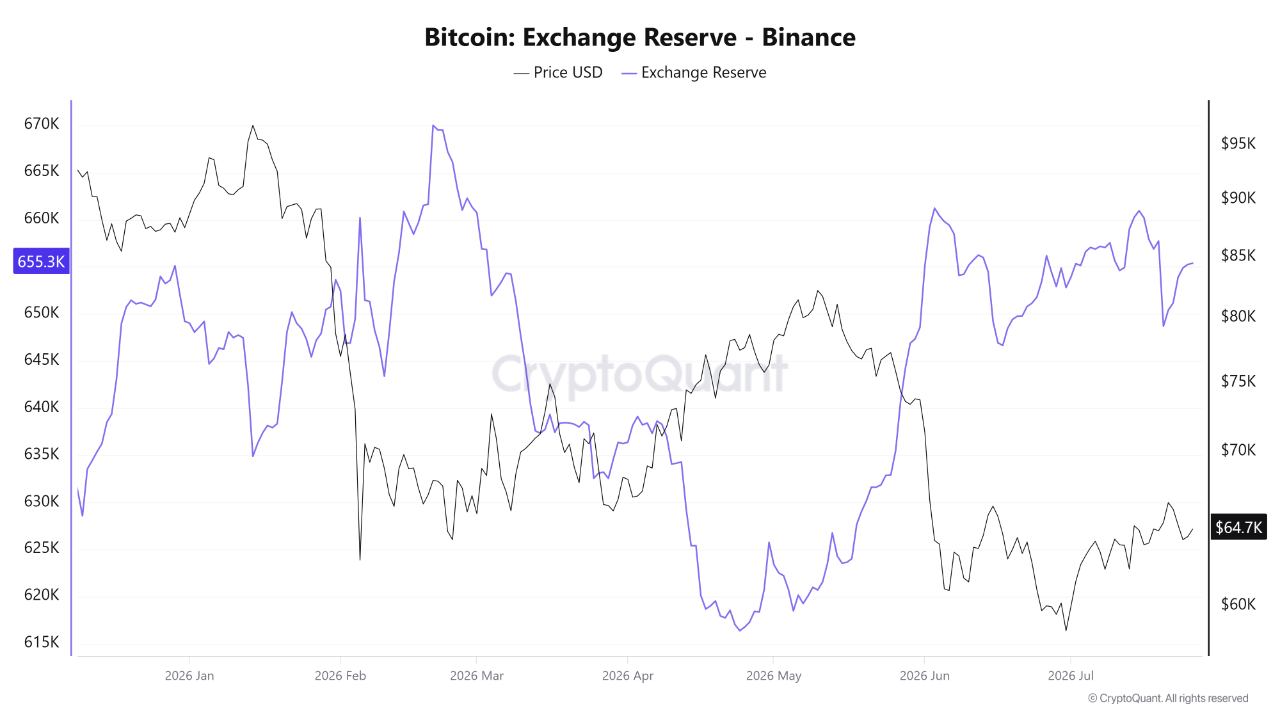
CryptoQuant’s Binance Exchange Reserve chart shows the exchange’s Bitcoin holdings recovering after declining earlier in the year. Reserves fell to their lowest levels around late April before climbing steadily through May, June, and July.
Binance now holds approximately 655,300 BTC in reserve, reflecting a notable rebound from the lows recorded just a few months ago. During the same period, Bitcoin’s price has moved independently of the reserve data, suggesting that rising balances on the exchange are not necessarily a sign of increased selling activity.
The relationship between exchange reserves and market sentiment has changed considerably over time. Bitcoin held on major exchanges now serves multiple purposes beyond simple spot market activity. Large reserve balances can support institutional custody services, ETF-related liquidity requirements, derivatives markets, and market-making operations.
For that reason, reserve data increasingly provides insight into where liquidity is concentrating rather than indicating immediate downside pressure.
Altcoins are not left out either. The platforms shutting down also impact their concentration on exchanges.
The Crypto Exchange Landscape Is Becoming Smaller
The closures of BitMEX and BitMart point to a broader structural shift across the industry. Higher compliance standards, regulatory requirements, and the growing presence of institutional participants are creating an environment where only a handful of exchanges possess the infrastructure necessary to operate at scale.
Several years ago, liquidity was spread across hundreds of competing platforms. Today, capital is gradually consolidating among larger exchanges that offer deeper liquidity pools, institutional-grade services, and stronger operational frameworks.
Binance’s recovering Bitcoin reserves appear to reflect this ongoing consolidation. Rather than moving evenly across the industry, liquidity is increasingly flowing toward exchanges capable of supporting a wider range of financial products and services.
Liquidity Trends May Become an Important Market Indicator
Bitcoin’s price remains the primary focus for most market participants, but exchange reserve trends are becoming increasingly valuable when assessing broader market developments.
The steady rise in Binance’s Bitcoin reserves suggests that confidence and liquidity are continuing to concentrate among the industry’s largest players. This trend may become even more pronounced as institutional participation expands and regulatory expectations continue to evolve.
The recent exchange closures are unlikely to be isolated developments. They may instead represent another step toward an industry dominated by fewer, larger, and more transparent platforms. Watching where Bitcoin liquidity accumulates could provide important clues about how the digital asset market develops over the coming months and years.





 The CoinRemark Team